Showing posts with label bbc. Show all posts

Monday, 15 March 2021

Eleven Great Sci-Fi and Fantasy Shows On The BBC That Aren't Doctor Who - Part 2

This is part 2 of my dive into the unmapped, shadowy depths of the BBC, hidden beyond all human knowledge, where in the darkness lurk strange, bizarre science fiction and fantasy productions that are not even slightly Doctor Who. You can read part 1 here.

The Cipher

When 16-year-old genius Sabrina (Anya Chalotra) cracks The Cipher, an impossible online puzzle, she is recruited by a mysterious organization to help in the hunt for a serial killer targetting scientists. Although this BBC audio drama/podcast is also about conspiracies and medical mysteries, The Cipher exchanges the bleak horror of Tracks for a rollercoaster of sci-fi concepts and 180-degree twists in every episode.

Life On Mars

So this is a show about a time travelling policeman, starring John Simm, and it's still not Doctor Who. Instead it's a modern take on Mark Twain's Connecticut Yankee. By-the-book policeman Sam Tyler suffers a head injury which sends him back in time from 2006 to the 1970s, where he finds himself working for DCI Gene Hunt (Philip Glenister), a character who positively embraces the non-politically-correct policing attitudes of the era. As we all know, it is the law that police officers are always paired up on the basis of opposing personality traits, and Life On Mars features possibly the most explosive pairing in any book, movie or TV series ever.


DEVS

Written by Alex Garland, produced by FX and broadcast by the BBC, DEVS is a cyber thriller about quantum computer programmers working for a secretive tech company. Lily (Sonoya Mizuno) gets herself hired in order to investigate her boyfriend's disappearance, while CEO Forest (Nick Offerman, channeling Jeff Bridges) tries to control... well, everything. DEVS features beautiful, chilling set design and lighting which underscores some intense performances and a neat sci-fi concept.

What We Do In The Shadows

This American TV series spins off the original New Zealand movie, set in the same reality but featuring a new household of flat-sharing vampires living on Staten Island. It's only broadcast by the BBC but could easily pass for a britcom, with shades of Being Human and The Office, featuring The I.T. Crowd's Matt Berry and introducing the brilliant concept of energy vampires. Funny and dark.

Fort Salem

One more American TV series brought to the UK and broadcast on the BBC, Fort Salem is set in an alternate timeline where the Salem trials ended with the witches agreeing to become the U.S. Army. Cut to the present day where three witch cadets, Raelle, Tally and Abigail chant their way through their military training under the shadow of General Sarah Alder, learning how to use sound-based magic and who to trust, as the army gears up to fight the Spree, a terrorist witch faction.

His Dark Materials

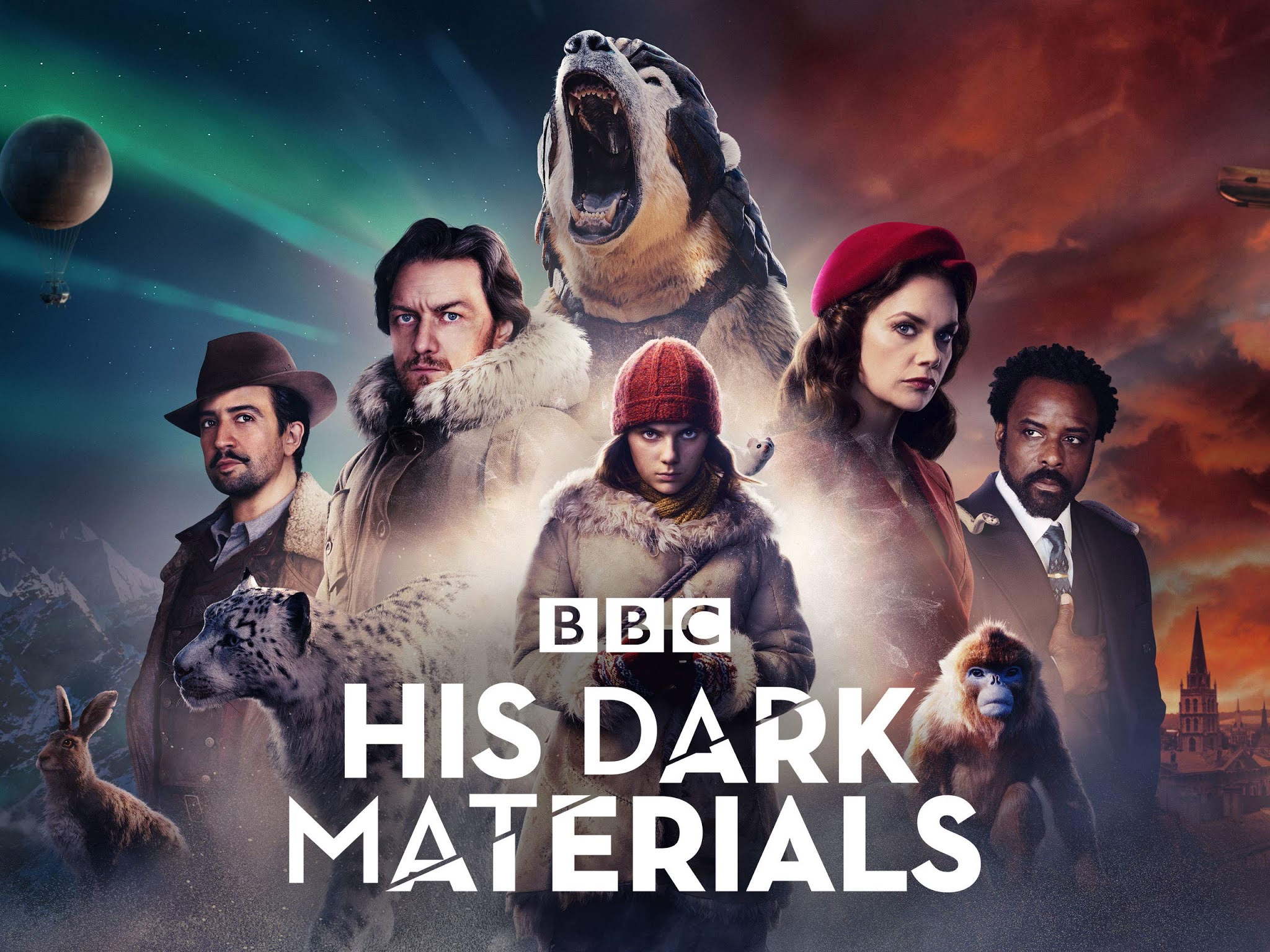
I have saved the best until last. This non-Doctor-Who fantasy series, based on the books of Philip Pullman, is a georgeous adaptation, innovative in the way the plot is re-worked for television, and at the same time extremely faithful to the characters, settings and overall story. It's more faithful and more magical than the 2007 movie, and unlike the movie the antiestablishment theme is not diluted. The icing on the cake is the casting and acting - Dafne Keen as Lyra, Ruth Wilson as Mrs. Coulter, James McAvoy as Asriel and Lin-Manuel Miranda as Lee Scoresby.
Monday, 8 February 2021

Eleven Great Sci-Fi and Fantasy Shows On The BBC That Aren't Doctor Who - Part 1

Can you have too much Who?

Even as a lifelong fan of the BBC's flagship sci-fi drama, I'm aware that one of the risks of pouring so much investment and energy in to one show is that it can eclipse other shows, particularly other science fiction and fantasy. So it's worth reminding ourselves that, believe it or not, there are occasionally programmes shown on the BBC channels that aren't Doctor Who. And no, I'm not talking about Torchwood. Here, to prove my point, are eleven BBC sci-fi or fantasy shows that are not even a tiny bit Doctor Who.

I should add that some of the shows here are produced by the BBC, often in collaboration with other networks, while others are produced elsewhere and were broadcast by the BBC thereby demonstrating their excellent taste in programme purchasing. I'll try to make it clear which is which.

This is part 1 of the article. You can read part 2 here.

Good Omens

Adaptation of Neil Gaiman and Terry Pratchet's novel about the unlikely friendship between an angel (Michael Sheen) and a devil (David Tennant) both of whom prefer living on Earth to Heaven or Hell respectively. Co-produced by BBC and Amazon and broadcast in 2019 and 2020, this show is funny, inventive and satisfyingly bonkers, and despite starring David Tennant it is definitely not Doctor Who.

War Of The Worlds

Since H.G.Wells first invented the alien invasion trope there have been rather a lot of adaptations of War Of The Worlds. I have a soft spot for the 1953 movie, and would probably describe the Jeff Wayne musical version as my favourite. I'm less fond of the £2 coin adaptation featuring the four-legged Tripod. I really like the BBC's 2019 miniseries. Instead of setting it in the present day, it's a period drama set in the early 1900s. The story loosely follows much of the novel, but centres on George (Rafe Spall) and his scandalous girlfriend Amy (Eleanor Tomlinson) thereby increasing the number of lead female characters from zero to one. We all know the Martians lose, and how, so a good adaptation of WOTW needs to add something original. This series uses flashforwards to show the aftermath of the war - a world still grieving and still on its' knees many years after the Martian defeat.

Tracks

This might be one of the best things the BBC has ever done. Five series of audio dramas, or if you prefer, fiction podcasts, starring Romola Garai as Helen, a GP who is drawn in to a series of conspiracies after she witnesses a horrific plane crash - and rises to the challenge. Written by Matthew Broughton, each series is an intelligent biomedical thriller very much in the vein of Michael Crichton or Robin Cook.

Missions

Broadcast on the BBC in 2018, this is a sci-fi drama about tech tycoons Meyer and Goldstein, who are not at all inspired by Elon Musk and Jeff Bezos, their privately-funded expeditions to Mars and the surprising discoveries they make on the surface. The series follows Jeanne Renoir (Hélène Viviès), the psychologist trying to keep the crew of Meyer's expedition sane; but as this is a French drama, she must also be having an affair with the married captain.

Dracula

Two out of three ain't bad. A completely new BBC adaptation of Dracula written by Mark Gatiss and Steven Moffat, starring Claes Bang as Dracula, and combining the wit and inventiveness of Sherlock with the sumptuous gothic shenanigans of the Hammer Christopher Lee/Peter Cushing series of movies. I loved the first two episodes, set in Dracula's Transylvania castle and then on board a ship sailing for England, and the rivalry between Dracula and his nemesis Sister Agatha (Dolly Wells) which runs through the series. The third episode which brings Dracula into a completely different setting is a gamble, and I found it less satisfying although there's still a lot to enjoy.

To be continued...


Tuesday, 10 April 2018

Your Town [Review: The City And The City]


We are living in a golden age of TV adaptations of science fiction and fantasy books. Hot on the heels of The Expanse, Altered Carbon, Man In The High Castle and American Gods comes a new series based on Good Omens, a new version of War of the Worlds set in the era of WW1, and more. Right now I'm enjoying the BBC's miniseries based on The City and The City, possibly my favourite China Mieville novel.

I regret never posting a review of this novel, I may need to re-read it after watching the series and may write some more about it. I did write this blog back in 2010 about C.J. Cherryh's novel Wave Without A Shore which features a similar conceit - societies that choose to live as if they cannot see each other.

The City and The City is a traditional detective story, set in two interlinked cities, Besźel and Ul Qoma. The Besźel tourist orientation video above sets out the scenario nicely - and you should watch it, it could save your life. The plot reminded me of The Bridge - the body of a murder victim is found across a border, under circumstances that bring together the police forces of both cities and leads to conspiracies within conspiracies. The series stars David Morrissey as Besź detective Borlu, and relies heavily on deep colour grading and depth of field to differentiate between the two cities - one is always out of focus.

This is also a great example of a fantasy concept that refers to many situations in real life. One of the things I love most about London for example is that it contains many more cities than just Besźel and Ul Qoma - hundreds of nationalities, communities and active subcultures some visible, some just out of focus; also without taking this post too far into political waters Besźel and Ul Qoma bear similarities to post-Good Friday Northern Ireland and to other conflicted or disputed lands around the globe.

Saturday, 11 July 2015

Reach For The Stars

An unusual star system containing five stars has been found by the WASP astronomy project, as reported on the BBC News website here. Multiple star systems occur in two classic science-fiction works. Isaac Asimov's novella Nightfall is set on a world with six suns - as a result night falls only once every few thousand years. Liu Cixin's novel The Three Body Problem, translated from the original Chinese, features a virtual world with three suns in irregular and unpredictable orbits.

Both stories explore the impact of these star systems on the civilizations below - in Nightfall, the inhabitants cannot detect stars beyond their system so cannot grasp the size or nature of the Universe, and they have a deep-rooted fear of the dark. The aliens on Liu Cixin's world also struggle to make sense of the Universe, and are striving to find a way to predict their suns' movements so they can prepare for the deadly hot or cold spells that occur when the suns get too close or too far away.

On our own world, we had it easy. All the clues were within easy reach - a single, stable sun, a clear view of the other stars, our own Moon and other planet/moon systems visible through simple optical devices, and it still took us centuries to work it all out, burning heretics along the way.

Friday, 11 February 2011

Is There A Doctor In The House? [Review: Outcasts]

The challenge for every BBC producer on a sci-fi show: to not end up making another Doctor Who. Other UK channels don't really worry about this, that's why ITV were able to make Primeval. However I suspect it’s thanks to this creative pressure that the BBC came up with Life On Mars and Being Human.

The first episodes of a new eight-part series, Outcasts, premiered this week and it does seem to promise something different. Carpathia is a ten-year-old off-world colony with a few teething problems. They’ve survived some sort of plague, there are divisions between the trigger-happy security officers and the emerging bureaucrats, and everyone has some kind of secret past or emotional baggage. Meanwhile a shipload of refugees from disaster-stricken Earth repair their damaged ship in orbit, hoping to survive the dangerous atmosphere and join the colony.

Ashley Walters and Hermione Norris

The scenario is colonial sci-fi in the tradition of countless Golden Age authors – Anne McCaffrey springs to mind, as does the Heorot series by Larry Niven and other authors, and the characters also come straight from this sub-genre: in particular Jamie Bamber's maverick anti-hero Mitchell.

This is the kind of situation where The Doctor and Amy would leap in, resolve everything quickly with a combination of luck, smarts and that annoying sonic screwdriver thingy, then disappear during the celebrations. In the absence of this wizard and his magic wand, the colonists of Carpathia will be forced to deal with their own problems, and the consequences of their mistakes will be played out in full. Watch this space.

Wednesday, 25 August 2010

Kiss Kiss Bang Bang [Review: The Deep]


Somewhere beneath the Arctic ice, BBC's sci-fi submarine series The Deep is proving to be more than just melodrama with gritty-blue colour grading - it's got ideas. There's no question of spinning this series out and making you wait months for a tiny snippet of a hint Lost-style - tonight the revelations were coming in thick and fast and breaking their way in through the hull. I won't reveal them here, that's what BBC iPlayer is for.

The melodrama is pretty over the top - it's almost as if someone in the scriptwriting department realised that "high pressure" could be a metaphor for something! James Nesbitt and Orla Grady in particular really go for maximum emotion - admittedly, she has returned from the dead. And while I expect realism to take second place to drama in a series like this, I did notice that there's rather a lot of casual gunplay considering the action takes place inside a pressurized vessel located several thousand feet underwater.

By contrast, it's great to see Minnie Driver in a really powerful role here, as the ice-cool submarine commander taking tough decisions and just about holding the crew (and her hairstyle) together. There's a distinct lack of large prehistoric sharks in this series - so far - but you can't have everything and so I am thankful for the bangs.

Monday, 28 December 2009

Feed me, Seymour! [First impressions: Day of the Triffids]

I've just seen the first half of the BBC's new Day of the Triffids drama starring Dougray Scott, Joely Richardson and Eddie Izzard. The tone is serious - there's very little Doctor Who-style playfulness although I loved the TRIFFOIL petrol stations.

I am struck by how assured and confident a production this is. The first of the two feature length episodes is easily of feature quality - in particular the portrayal of post-apocalyptic London and some plot elements bring to mind 28 Days Later and Children of Men, and this episode could certainly stand alongside both films.

Eddie Izzard stars as Torrence, who enters the plot by escaping from a diving plane - his method of survival has a lot of flair and defines Torrence as a character even though they may possibly have nuked the 'fridge to some extent.

Everything's cool: from the colourful and dynamic scene lighting, to an audacious screenplay, to the acting, to the edit particularly in terms of pacing - those 90 minutes flew by. Large scale set pieces - aeroplanes crashing, anarchy on the streets or in the wards, massed Triffid attacks - are accomplished smoothly. It's a marker for just how far the BBC has come in recent years, and is a far cry from the "good old days" when I would watch old episodes of Doctor Who and love them despite the dodgy production values. Looking forward to the concluding episode tomorrow.