Your stories may have varied in their quality but no-one can say they lacked ambition. If you had been Star Trek the new twists shaking up your origin story would have driven canon-obsessed fans to apoplexy. Happily Doctor Who has never had a canon.
Sunday, 30 October 2022
Goodbye Norma Jean [Doctor Who: The Power Of The Doctor]
Sunday, 10 October 2021
Coming Soon
I've neglected the Sci-Fi Gene blog a little this year. Real life has taken over a bit. The past 18 months of the coronavirus pandemic have felt like living through a sci-fi movie - and a really cheap one, with over-the-top melodramatic portrayals of world leaders and a badly researched and predictable script.
However, now is as good as any time to return to the fray. The Sci-Fi Gene is preparing for a new wave of sci-fi productions - on the horizon are new seasons of Doctor Who, Lost In Space, Discovery and The Expanse. Right now I'm enjoying the second series of French drama Missions, about a private space race between two tech billionaires (I don't know where they get their crazy ideas!)
I've also been surprised and amazed by Lower Decks which is possibly my favourite Star Trek series now. The first series was good fun, but I'm currently halfway through the second series which is outstanding. In the sci-fi adjacent area I've enjoyed BBC submarine drama Vigil, as well as the second series of military witch drama Fort Salem, and this weekend I saw an obscure arthouse flick about some retired secret agent who likes cars. Probably won't do all that well but it's important to support these little indie productions - and well done to the producers for persuading Billie Eilish to do the soundtrack.
And then there's this.
Monday, 15 March 2021
Eleven Great Sci-Fi and Fantasy Shows On The BBC That Aren't Doctor Who - Part 2
This is part 2 of my dive into the unmapped, shadowy depths of the BBC, hidden beyond all human knowledge, where in the darkness lurk strange, bizarre science fiction and fantasy productions that are not even slightly Doctor Who. You can read part 1 here.
The Cipher
When 16-year-old genius Sabrina (Anya Chalotra) cracks The Cipher, an impossible online puzzle, she is recruited by a mysterious organization to help in the hunt for a serial killer targetting scientists. Although this BBC audio drama/podcast is also about conspiracies and medical mysteries, The Cipher exchanges the bleak horror of Tracks for a rollercoaster of sci-fi concepts and 180-degree twists in every episode.Life On Mars
So this is a show about a time travelling policeman, starring John Simm, and it's still not Doctor Who. Instead it's a modern take on Mark Twain's Connecticut Yankee. By-the-book policeman Sam Tyler suffers a head injury which sends him back in time from 2006 to the 1970s, where he finds himself working for DCI Gene Hunt (Philip Glenister), a character who positively embraces the non-politically-correct policing attitudes of the era. As we all know, it is the law that police officers are always paired up on the basis of opposing personality traits, and Life On Mars features possibly the most explosive pairing in any book, movie or TV series ever.
DEVS
Written by Alex Garland, produced by FX and broadcast by the BBC, DEVS is a cyber thriller about quantum computer programmers working for a secretive tech company. Lily (Sonoya Mizuno) gets herself hired in order to investigate her boyfriend's disappearance, while CEO Forest (Nick Offerman, channeling Jeff Bridges) tries to control... well, everything. DEVS features beautiful, chilling set design and lighting which underscores some intense performances and a neat sci-fi concept.
What We Do In The Shadows
This American TV series spins off the original New Zealand movie, set in the same reality but featuring a new household of flat-sharing vampires living on Staten Island. It's only broadcast by the BBC but could easily pass for a britcom, with shades of Being Human and The Office, featuring The I.T. Crowd's Matt Berry and introducing the brilliant concept of energy vampires. Funny and dark.
Fort SalemOne more American TV series brought to the UK and broadcast on the BBC, Fort Salem is set in an alternate timeline where the Salem trials ended with the witches agreeing to become the U.S. Army. Cut to the present day where three witch cadets, Raelle, Tally and Abigail chant their way through their military training under the shadow of General Sarah Alder, learning how to use sound-based magic and who to trust, as the army gears up to fight the Spree, a terrorist witch faction.
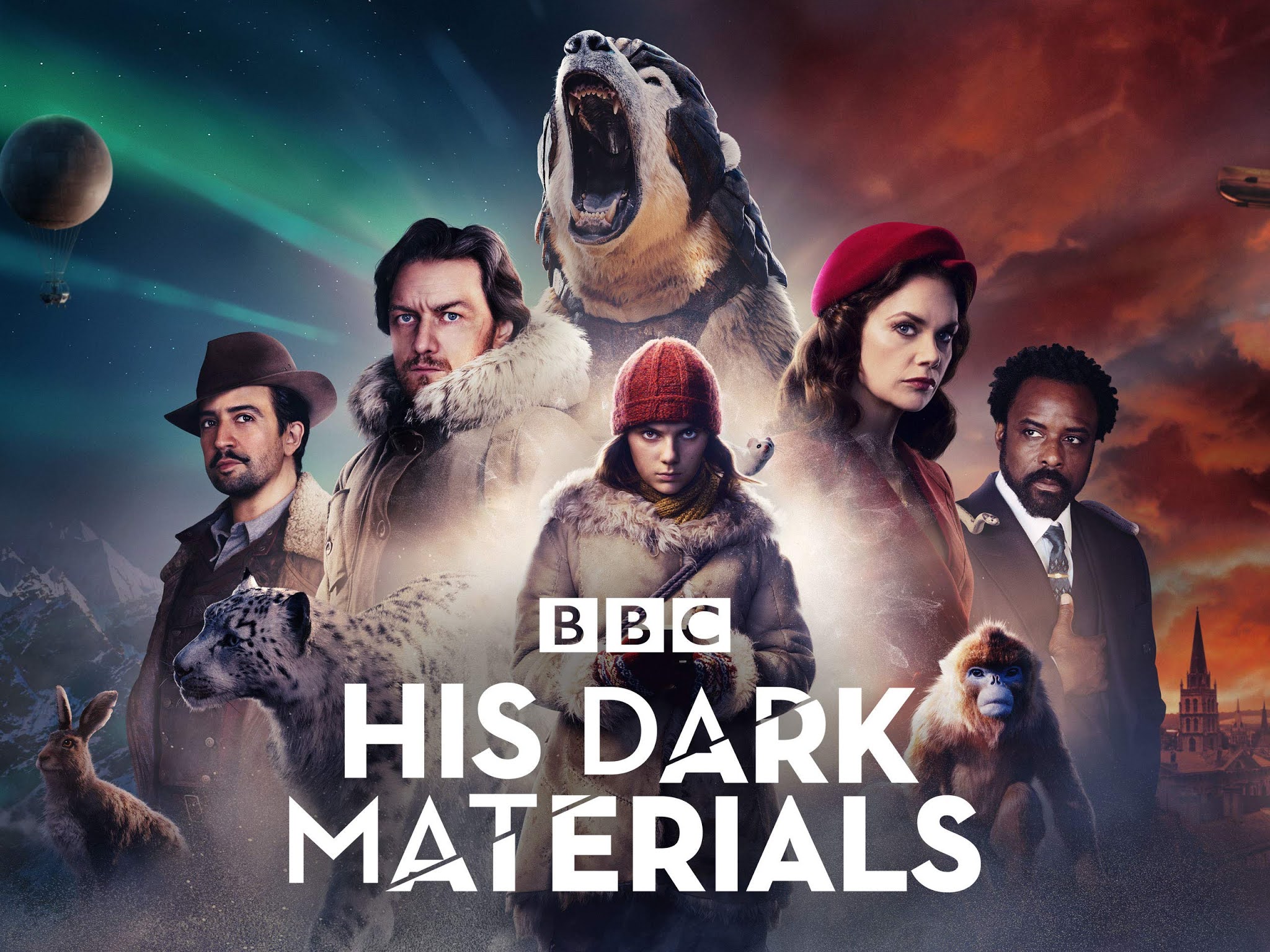
His Dark Materials
I have saved the best until last. This non-Doctor-Who fantasy series, based on the books of Philip Pullman, is a georgeous adaptation, innovative in the way the plot is re-worked for television, and at the same time extremely faithful to the characters, settings and overall story. It's more faithful and more magical than the 2007 movie, and unlike the movie the antiestablishment theme is not diluted. The icing on the cake is the casting and acting - Dafne Keen as Lyra, Ruth Wilson as Mrs. Coulter, James McAvoy as Asriel and Lin-Manuel Miranda as Lee Scoresby.
Monday, 8 February 2021
Eleven Great Sci-Fi and Fantasy Shows On The BBC That Aren't Doctor Who - Part 1
To be continued...
Wednesday, 21 March 2018
Rikki Don't Lose That Number [Sci-Fi Telephone Booths]
But while the Doctor was one of the first, she is far from unique - in fact there's a long and respectable tradition of science fiction heroes travelling in telephone booths. Excluding the good Doctor, here are my top five long distance callers:
#1 Bill And Ted
Doctor Who has spawned many spin-off series and movies over the years. My favourites were the Bill and Ted movies - Bill and Ted's Excellent Adventure (1989) and Bogus Journey (1991). It's a blast - a great time-travel comedy and a decent attempt to create an American Doctor Who. It's absolutely canon. The eponymous heroes, played by Alex Winter and Keanu someone or other, travel through time in a US phone booth "borrowed" from Time Lord Rufus (who strictly speaking should be called The Rufus), encountering historical celebrities in their quest to complete their homework and ultimately secure the future of civilization through music. A nice touch is that this TARDIS is actually controlled by looking up the desired historical period in a phone book and dialling the number.
#2 Harry Potter
Why waste time with flying cars, boring broomsticks, itchy Floo powder or those blasted Portkeys when you can travel in style in a phone booth? The phone booths in Harry Potter are secret entrances to the Ministry of Magic.
#3 Professor Branestawm
In the BBC's fun adaptation of Norman Hunter's Professor Branestawm, starring Harry Hill, the Professor invents a slightly slower-moving phone.
#4 Neo
The Matrix is another of my favourite Doctor Who spin-offs. The links to original Who are subtle, but Whovian fans should be well aware that in Doctor Who, the Time Lords have a supercomputer called the Matrix. In the Matrix, there is also a supercomputer called The Matrix. If you are exploring the Matrix and need to leave in a hurry, you get to a phone booth.
#5 Superman
The final entry in this list is Superman. He only rates #5 as he doesn't actually travel in a phone booth, he just changes in one. This will be hard to explain to the mobile phone generation.
Thursday, 7 September 2017
One Million Years Before Skaro
Wednesday, 9 August 2017
Doctorin' The Tardis
The Sci-Fi Gene welcomes Jodie Whittaker as the 13th Doctor, and looks forward to finding out just how this highly talented actress interprets this unique TV role. Whittaker is best known for her role in Broadchurch but also appeared in Joe Cornish's low budget sci-fi Attack The Block, reviewed here, alongside a certain John Boyega who would incidentally be an excellent choice for the 14th Doctor.
Sunday, 19 May 2013
Doctorin' The Tardis [Review: The Name Of The Doctor]
Government cutbacks have gone too far. Even the Romanian entry in this year's Eurovision Song Contest made more of an effort to look sci-fi.
[It's My Life - Cezar]
Some plot elements remain vague and mysterious - it's hinted but not fully explained that the cheap monsters are just information, as is River Song, and this is connected in some way to the Library where her personality was stored after her death. Also, the Doctor and Clara have to Tardis it to the supposed graveyard with great difficulty - but the Cheapikons can get there, bringing Vastra and the others, using only background music and a couple of focus pulls. The last few seconds make no sense, but not to worry - Moffat and friends have until November to come up with a plausible explanation. Once again an episode promoted as something incredible turns out just to be a regular one but still enjoyable.
Monday, 10 September 2012
I Have Had It With These Motherf****** Dinosaurs On This Motherf****** Spaceship! [Review: Dinosaurs On A Spaceship]
This week the Doctor rounds up a posse made up of Queen Nefertiti, Amy and Rory, Rory's Dad and an Edwardian game hunter, brings them aboard a spaceship populated by dinosaurs and heading straight for Earth, hoping to divert it before the Indian Space Agency blows it sky high and makes dinosaurs extinct.
Sunday, 2 September 2012
The Doctor Is In [Review: Asylum Of The Daleks]

This episode is good but not earth-shatteringly brilliant. It doesn't need to be. It's the series opener written by Steven Moffatt and no doubt it's real purpose is to set up plot arcs, surprises and themes for the episodes to come. I would be very surprised if the nanofield doesn't re-emerge at some point, it's a fantastic plot device. The episode introduced some interesting characters, including the Dalek Prime Minister O_o and a character played by Jenna-Louise Coleman, who will be joining the series to play the Doctor's travelling companion in a few months.
Wednesday, 28 December 2011
Do You Know How Christmas Trees Are Grown? [Review: The Doctor, The Widow and The Wardrobe]
What this episode is really about is trees. Doctor Who and trees have history: the Doctor’s (other) nemesis the Rani used landmines that turned people into trees (Mark Of The Rani, 1985.) Also, when taking Rose to see the destruction of the Earth, which you have to admit is a fairly impressive first date, the pair encounter Jabe, a sentient tree from the Forest of Cheem (The End Of The World, 2005.) Jabe gets an indirect mention in this episode too. Christmas trees on the other hand are to be feared: particularly deadly variants have appeared in previous Christmas Specials. These trees are sinister in a different way, but they’ve also attracted the attention of some unscrupulous humans from Androzani Major (a clever reference to The Caves Of Androzani, 1984, which was once voted best episode of all time.)
The plot is unusually weak for Doctor Who, with an ending that is both unsatisfying and hole-ful. A fundamental attack on sentient life goes unpunished, and while the victims are technically saved, they are only saved in a metaphysical, insubstantial way. Meanwhile the human tragedy, which is really moving throughout the episode, is resolved far too easily.
If, however, you can put the ending to one side, what you are left with is a box of delights. Matt Smith’s Doctor is on good comic form in his misguided attempts to become “the Caretaker,” and once again his clowning is offset by unexpected moments of empathy. A confrontation between Madge, played by Claire Skinner, and three Androzani troopers led by comedian Bill Bailey, is funnier still. There’s great dialogue, setting, atmosphere, characters and acting throughout, and the right mix of comedy and tragedy.
Of course, you don’t need the Doctor to tell you never to cross a Christmas tree:
Monday, 17 October 2011
Let's hope we don't have to run! [Reviews: Let's Kill Hitler and Night Terrors]
LKH features a humanoid robot time-ship, the Tesselator, crewed by tiny time-policemen and jellyfish robots. The concept reminded me of Woody Allen's "Everything You Always Wanted To Know About Sex" where a similar miniature crew pilot a man through a dinner date in what might be the most original Star Trek spoof ever. I'm told Eddie Murphy also based a film around this idea, to which I believe the correct response is "Eddie who?"Tuesday, 21 June 2011
How To Review A Book
It's good to learn, grow and develop, so here are some ideas about how to write more in-depth book reviews, together with an example drawn from a classic piece of utopian-dystopian fiction. This is neither comprehensive nor ecumenical: I intend to draw on some, all or none of these points in future and would be interested in other approaches to reviewing as well.
What is the book about?
The novel is set in an eco-friendly future where, possibly due to genetic engineering "even the trees are happy." The protagonist, either the engineer of this society or some kind of mascot, becomes restless and walks beyond the boundary of the known into an unfamiliar forest, where chance discoveries bring him face to face with a genuinely miserable person - at which point he must make the most important choice in both their lives.
What does it achieve?
The story develops a highly optimistic philosophy: universal happiness can be achieved but misery must be acknowledged and confronted rather than excluded.
How does it achieve it?
The setting is simply presented as fact: the workings of Happyland society are never revealed. As Arthur C. Clark almost said: "Any novel about sufficiently advanced technology is indistinguishable from magic realism." The hero is the archetypal Happy Man, and his nemesis the Miserable Man he meets at the foot of the staircase is identical in every way apart from his unexplained melancholia, so is clearly an unconscious facet of the Happy Man's psyche as well as fulfilling a scapegoat role for the Happylanders.
Place it in context:
This novel is the first and most familiar in a long-running series: while each book ostensibly takes as its focus a new protagonist, the Happy Man recurs throughout and through his relationships with other archetypes develops several longer story arcs. The series has had a positive reception over the years with several television adaptations and a second, feminised spin-off series to offset the male dominance of the canon.
Enforced happiness is a common trope within the utopia-dystopia science fiction subgenre. This novel draws heavily on classics such as Brave New World and has in turn influenced subsequent visions of the future: Equilibrium (2002) Demolition Man (1993) and The Happiness Patrol (Doctor Who, BBC, broadcast 1988) are particularly indebted. The latter is an inversion of the basic plot with the Happy Man replaced by the sinister Kandy Man who kills through excessive joy. Symbolic elements of this story have also been influential on their own: the spiral staircase separating the Happy Man from his Miserable counterpart is "borrowed" to great effect in GATTACA (1997.)Give an honest reaction:
There's often a tension between optimistic and dystopic science fiction. This novel clearly falls into the first category. I enjoyed the plot with it's many twists but felt the optimism went a little too far, with the ending even hinting at totalitarianism. Is absolute happiness either achievable or desirable? In this society, even though the Miserable Man can be welcomed, he does in the process have to abandon his misery altogether: there's no room for either legitimate misery or for the blues. The Happiness Patrol at least ends on a different, more satisfying harmonica note.
You can buy "Mr. Happy" by Roger Hargreaves at all good bookstores.
Friday, 10 June 2011
Bad Girls Go Everywhere [Review: A Good Man Goes To War]
The Doctor, backed by a rag-tag crew of companions and allies, takes on a powerful military-religious establishment to rescue Amy and baby Melody. Naturally the entire set-up is a trap ready to spring shut, and the evil Madame Kovarian is a serious threat. The Doctor is on the warpath, more violent than ever, at one point destroying a Cyberman fleet just to persuade their leader to cooperate with Rory. However the main story is the cat-and-mouse interplay between the Doctor and Kovarian.This episode provides a lot of answers, not just limited to the story arc - in fact these are the least surprising twists. The Doctor's full name is finally revealed, at least for those of us who read Gallifreyan. I have been waiting for this since 1963 which is in itself an achievement since I wasn't born until the following decade.
The script is also full of red herrings and misdirections - is it wrong of me to say that I was disappointed to learn that Professor River Song is not a later incarnation of the Doctor? (This would have implied that relationships of this type are quite OK for Time Lords.) Madame Vastra and Jenny are a joy to watch and definitely spin-off material, and there are some truly memorable, utterly bonkers moments.Rory (to Sontaran Commander Strax): "You're a warrior!"
Commander Strax (dying words, to Rory): "I'm a nurse."
In addition, it's clearer than ever that Moffat is bringing a much darker tone to Doctor Who: non-human deaths are emphasised, characters are given fake deaths over and over again, and interrogation, torture, humiliation, and slavery are constant companions. The new monsters are extremely sinister and the so-called Headless Monks are no exception.
Amy's treatment in this episode and, it turns out, the whole series, has been particularly cruel and there's an ongoing discussion about treatment of women in Doctor Who over at io9. OK. It could be worse - at least these days they don't get asked to do this [1:45]
[The Time Warriors, Sarah Jane Smith's first appearance.]
As a whole, A Good Man Goes To War was a daring and horrific episode, a real classic Doctor Who moment. But I don't buy the statement that this battle is the Doctor's finest hour, or his greatest fall - for all the climactic music it's still just another verse in the legendary ballad.
Saturday, 7 May 2011
One Silent Leap For Mankind [Reviews: The Impossible Astronaut and Day Of The Moon]
"Basically, yes."
"So how long have Scotland Yard had this?"
Doctor Who returns: and a central character did indeed die as promised. I don't quite believe they have the guts to completely follow through with this decision - but if they do... before tonight's pirate-based entertainment begins, a look back on the series 6 opening episodes.
The Impossible Astronaut and Day Of The Moon reunite the Doctor, Amy, Rory and River Song in Utah, and from there it's one small step back to 1969, Nixon's America and the lead up to the historic Apollo 11 flight. The Silence make their appearance - a new, Munch-inspired alien horde who have "owned" the Earth since the dawn of mankind, controlling us through hypnotic suggestion and disappearing from our memory as soon as we turn away. The Silence were a silent presence throughout series 5, and their influence may explain some of the series 5 mysteries including the gaps in Amy's memory.

Why the long face?
River Song and the Doctor also make their relationship clearer - travelling in opposite directions relative to each other, they are lovers in the Doctor's future and River's past. A timeline can be seen here - expect updates to this chart as series 6 progresses. This is exactly the kind of pretzel-twisted timeline Moffat seems to like, and does best.Steven Moffat's writing always generates more questions than it answers. Why are the Doctor and River fated to always travel in opposite directions? The Silence have gained complete control over the human race through millenia of hypnotic programming - but why is the Doctor, an alien from a much older civilization, just as heavily affected? What about the countless other hostile takeovers of Earth (in Doctor Who continuity) - did the Daleks, Yeti or Autons not see them either, and were the Silence worried by the incursions into their territory?
Friday, 11 February 2011
Is There A Doctor In The House? [Review: Outcasts]
The first episodes of a new eight-part series, Outcasts, premiered this week and it does seem to promise something different. Carpathia is a ten-year-old off-world colony with a few teething problems. They’ve survived some sort of plague, there are divisions between the trigger-happy security officers and the emerging bureaucrats, and everyone has some kind of secret past or emotional baggage. Meanwhile a shipload of refugees from disaster-stricken Earth repair their damaged ship in orbit, hoping to survive the dangerous atmosphere and join the colony.

Ashley Walters and Hermione Norris
This is the kind of situation where The Doctor and Amy would leap in, resolve everything quickly with a combination of luck, smarts and that annoying sonic screwdriver thingy, then disappear during the celebrations. In the absence of this wizard and his magic wand, the colonists of Carpathia will be forced to deal with their own problems, and the consequences of their mistakes will be played out in full. Watch this space.
Sunday, 26 December 2010
There's A Shark In The Park [Review: Doctor Who A Christmas Carol]
A Doctor Who Christmas Special that snatches the sonic screwdriver of success from the shark-jaws of failure. The concept made me groan: do we not all agree that a) the definitive version of Charles Dickens' time travel epic has already been made, and b) that it had Muppets in it? There was no way this was going to be anything but contrived, boring and unnecessary.Contrived? More than even I imagined. Boring and unnecessary? I was so wrong.
Why does it work? The settings are brilliantly realised, for a start: scenes on the shiny bridge of a crashing starship are ripped from the J.J.Abrams school of sci-fi, complete with lens flare; beneath them, a fog-shrouded semi-steampunk world where schools of fish fly in the clouds.
Secondly, Moffatt's script is definitely one of his better ones, with plenty of twisty timeline changes in addition to the ludicrous and surreal settings he so loves to create. The spaceship is doomed as the local oligarch is the only person with the power to control the planet's atmosphere and let the ship land - but he's a bitter, lonely miser and doesn't care in the slightest whether they live or die. The spark that turns the script from contrived and unnecessary to something more interesting is that the Doctor realises that pleading with the old man won't be enough, he'll have to change his entire history to bring out his better side - and chooses deliberately to play Ghost of Christmas Past to do it.
Kathryn Jenkins is cast as the heroine - whether the part was written for her before or after casting I don't know, but for me no future Christmas will be complete without someone singing beautifully to comfort and calm a dying air-shark. This brings me to the final, obvious point about what is so good about this episode: the shark.
Sunday, 19 September 2010
Augmented Reality Part I: Extreme Close-Up
Television and cinema technology developed in parallel. Historically, some TV footage would be filmed and converted for television – watch an old episode of Fawlty Towers and look for the difference between indoor (video) and outdoor (film) scenes.
CGI has become more advanced, increasing the range of things which can be depicted on TV – without throwing the whole series budget away in episode one. Also, watch any episode of the revived Doctor Who (a great example is the episode “42”) and you’ll see constant use of two-tone lighting or reduced colour palettes, and a shallow depth of field, creating a cinematic look which is now found in a lot of the more upmarket TV dramas. Compare to episodes from the old series - the differences are striking. In particular you’ll see much more colourful sets and costumes in older episodes.
Ever since the VCR first reared it’s magnetic head, people have been predicting the demise of the big screen. It hasn’t happened so far. So what are the crucial differences between the two?
One is location: you watch TV in your living room, on your own furniture in your own house. You have the lights on and your familiar life continues around you: a washing machine in the background, family members enter and leave, there’s a squeak from the hamster wheel. Telephones ring. You might eat while you watch, it's a matter of personal preference. The image is small (even now) and you can still see the rest of the room at the edges of your vision. So television is part of your everyday life.
Cinema is a seat in a darkened room far away from home – real life is put on hold, and the noises of the outside world are either blocked by heavy duty soundproofing or drowned out by waves of Dolby Digital. The image is massive - the widescreen cinema format is not arbitrary. It’s exactly the right shape and size to max out your visual cortex and completely engage you in the movie. Everything you see on the screen is larger than life, and the extreme close-up is used to exaggerate this even further: a cutaway to just the actress’s eyes can encompass the whole field of vision for a few seconds.
To be continued…
Tuesday, 24 August 2010
The Hitch Hiker's Guide To The Titanic [Titanic II Week]
Starship Titanic was an experimental computer game designed by galactic hitch-hiker Douglas Adams. The experimental element was the existential gameplay which involved asking questions of a series of eccentric robots, to which they universally failed to reply. Kafka would have been impressed. Where the game failed in artificial intelligence breakthroughs, it succeeded with artwork, animation and atmosphere, providing the player with (for it's time) a highly detailed art deco starship interior to explore.Douglas Adams first mentioned the Starship Titanic in the third Hitch-Hiker novel Life, The Universe and Everything - a prototype Improbability Drive ship that unfortunately suffered a gratuitous Total Existence Failure during its maiden voyage. Terry Jones' novel "Douglas Adams' Starship Titanic" develops this story arc further in parallel with the computer game.
Doctor Who is indebted to Douglas Adams in many ways and the Russell T. Davies and Steven Moffat series are laced with references to Adams' books. The 2007 extended episode Voyage Of The Damned, starring David Tennant and Kylie Minogue, was also set on a Starship Titanic, although arguably the plot itself had more in common with The Poseidon Adventure. This Titanic was once again staffed by mad robots - robotic angels with deadly, detachable halos.
Douglas Adams has a history of developing brilliant but tricky computer games - his two Interactive Fiction games, Bureaucracy and the official Hitch Hiker game, are both masterpieces of fiendish multi-layered puzzles. Success is virtually impossible but failure is fun. I don't know what happens if you complete either one of them - possibly the entire Universe is destroyed and replaced by something even more fiendish (there are of course those who claim this has already happened.) You can play a version of the Hitch Hiker game here on the BBC Radio 4 website, updated with some fantastic new artwork. The original text-only game is hosted here.
Thursday, 17 June 2010
OBSERVE, DOCTOR: A NEW ELEPHANT PARADIGM
FISH ELEPHANT
MASTER OF DISGUISE ELEPHANT
JAGUAR ELEPHANT
JACKSON POLLOCK ELEPHANT
AND THE SUPREME WINTER TREE ELEPHANT
ALL HAIL THE NEW ELEPHANTS!