Showing posts with label science fiction. Show all posts

Tuesday, 19 May 2026

Global Superpower [Review: The WONDERfools episode 1]

Started the first episode of The WONDERfools this week and was completely gripped. The episode opens on Eun Chae-ni (Park Eun-bin, star of Extraordinary Attorney Woo) who lives and works in her grandmother's restaurant, dreams of travelling, has a severe heart condition, no money and lots of punk attitude. Within the first 1-2 minutes there's a fantastic, character-defining scene where she takes on a group of street evangelists announcing the end of the world.

This opening episode is about establishing characters - in addition to Chae-ni, her family and friends, we also meet Lee Un-jeong (Cha Eun-woo), a very junior official in a government complaints office. Where Chae-ni is comically loud and punk, Un-jeong is the opposite, facing down the angry complainant that terrorizes everyone else in the office with a calm, deadpan response. It's early in the series but I feel like it isn't going to be a coincidence that these two have complementary personalities. 

The episode also establishes that there are links between several of the characters, and that pretty much everyone is hiding something. This also applies to the setting, Haesong City, on the surface a regular mid-sized modern town but there are hints of mysterious goings on in the past and the present.

Although I've been looking forward to this series for a long time I didn't know what to expect, apart from a superhero TV show with a different tone from the MCU. I'm now fighting the urge to binge-watch and looking forward to wherever this series takes me.

Saturday, 14 June 2025

Everybody Was Mok'Bara Fighting [Review: Star Trek Section 31]

A team of Section 31 special agents on the hunt for a rumoured superweapon must persuade space pub landlord, ex-Section 31 agent and even-more-ex-Mirror Universe evil dictator Phillipa Georgiou (Michelle Yeoh) to ally with them. It turns out this is not the only thing linking Georgiou and the weapon.

In Star Trek history, Section 31 is the Federation's secret service, sent to carry out covert, deniable missions that might be seen as clashing with the Federation's ideology or laws - a lot like Special Circumstances in Iain M. Banks' Culture novels, or perhaps the secret services of our own world. Section 31 first appeared in Deep Space 9 episodes. They have cropped up in Enterprise, Picard, Lower Decks and some of the recent films, and were central to the plot of Discovery, which also introduced Emperor Georgiou.

The Section 31 movie was in many ways not what I had expected. The films and episodes above give an impression of a sinister and super-efficient spy agency, possibly with a mild black leather fetish. It's a little surprising that the team of special agents in this movie, supposedly Section 31's elite, are actually a bunch of comical, clumsy, arguing misfits. How do they ever actually get anything done? And how did powered-armour-obsessive Zeph and work experience girl Rachel, in particular, qualify for the Star Trek equivalent of 00 status?

However this description misses the point of Section 31, which is really all about Georgiou - and about Michelle Yeoh. I first saw Yeoh in action in the mind-blowing martial arts film Crouching Tiger, Hidden Dragon. Yeoh is a talented actor who has appeared in a wide range of roles, not least Everything Everywhere All At Once, but Section 31 is designed to put her martial arts talents centre stage. This is an action-heavy movie in which no opportunity is missed for fantastic, joyous hand to hand combat - unusual in the phaser-heavy world of Star Trek.

Section 31 may not be the best Star Trek movie (obviously that's Galaxy Quest) but it's certainly the best Star Trek martial arts movie.


Score: Three stars out of five.

All movies reviewed on The Sci-Fi Gene blog are awarded three stars out of five.

Saturday, 7 October 2023

Zoom And Enhance

For many years now, fans of TV crime drama and sometimes science fiction have been taking the piss out of episodes featuring image enhancement. You know the trope: "stop, that frame, now zoom in, can you enhance that?" and four pixels are sharpened into a UHD quality portrait. Supposedly there are algorithms that can do this, and by coincidence this is something the geekiest member of the CSI:Your Town Here crew has been working on in their spare time. A selection of particularly amusing examples has been compiled by Duncan Robson in the YouTube video above.

However the game has changed. Until recently we could simply laugh and say that no such algorithm exists. Now we know what the algorithm is - it's Stable Diffusion, the principle used by Midjourney, Dall-E and other generative art AIs. And it's no longer impossible - instead it's dangerous. AIs are prone to bursts of creativity and "hallucinations" (the term used by AI scientists to mean "lying"). When an AI enhances an image, the face that is digitally pencilled in doesn't have to be the actual face of the suspect seen on CCTV, it just has to be a plausible image. It could be anyone's face. It could be your face.

So here's my question: how many innocent fictional people in episodes of CSI have been wrongly convicted of the most heinous crimes on the basis of an AI-enhanced image?

JUSTICE FOR FICTIONAL IMAGE ENHANCEMENT VICTIMS NOW

Thursday, 5 October 2023

Here’s One We Made Earlier [Review: The Creator]

CONTAINS HUMAN-GENERATED CONTENT

I’ve followed Gareth Edwards’ career with interest ever since his short film Factory Farmed won the Sci-Fi London 48 Hour Film Competition in 2008. He went on to make the low-budget feature Monsters, in which two journalists make their way through alien-infested Mexico, followed by two mega-franchise movies, Godzilla and Rogue One: A Star Wars Story, and now by his new film The Creator.

The Creator is a high-budget sci-fi/war movie epic with a cast of hundreds, a globe-spanning plot and CGI effects in almost every scene – but it’s an original story, not part of a franchise or cinematic universe. It concerns the rise of AI and the war between anti-AI Westerners and a pro-AI Asian nation, seen through the eyes of American soldier Joshua played by John David Washington. It’s well cast and well acted, particularly by Washington, national treasure Gemma Chan and child actor Madeleine Yuna Voyles, and together with the consistently good effects it’s an enjoyable and satisfying movie although I would say the plot is a little simplistic and one-sided, setting up a clear good vs evil story rather than engaging with the complexities of AI that we are grappling with in the real world.

I’ve always admired Edwards’ ability to use CGI intelligently to build believable worlds. Here it contributes to the setting of a believable alternative history where robots and AI became commonplace early in the 20th century, extended into the near future when the action takes place. Although it has its own distinctive visual style The Creator is not without influence from other movies – in particular many of the robot designs have definitely been touched by Star Wars. Roger roger.


Score: Three stably diffused stars out of five.

All movies reviewed on The Sci-Fi Gene blog are awarded three stars out of five.

Update 7.10.2023: The Guardian has also reviewed this film. Their review is correct (apart from the star rating).


Saturday, 29 April 2023

Firefly Season 2 Episode Guide

 CONTAINS AI-GENERATED CONTENT

**Episode 1: "The Heist"**

Zoe receives a job offer from an old war buddy to steal a valuable artifact from a heavily fortified museum. However, when their plans are foiled by unexpected security measures, Zoe must rely on her training and quick thinking to save the crew and complete the job.

**Episode 2: "The Lost Colony"**

Jayne receives a message from an old acquaintance on a remote planet that was once a thriving colony. When they arrive, they find that the planet has been abandoned for years, and they must unravel the mystery of what happened to the colonists.

**Episode 3: "The Huntress"**

Inara's past comes back to haunt her when she is hunted by a former client who has become obsessed with her. In order to protect herself and the crew, Inara must use all of her skills as a Companion to outwit the deranged client.

**Episode 4: "The Diplomat"**

Simon is recruited by a group of diplomats to mediate a peace treaty between two warring factions. However, when the negotiations break down and violence erupts, Simon must put his medical skills to the test to save lives on both sides of the conflict.

**Episode 5: "The Genius"**

River's unique abilities are put to the test when the crew is hired to protect a brilliant scientist who has developed a groundbreaking technology. However, when the scientist is kidnapped, River must use her intellect and intuition to track down the culprits and rescue him.

**Episode 6: "The Outlaw"**

When Mal is captured by a group of bandits, he must use his cunning and charm to talk his way out of trouble. However, when he discovers that the bandits have a personal vendetta against him, Mal must rely on his friends to mount a daring rescue mission.

**Episode 7: "The Ghost Ship"**

Serenity encounters a derelict spaceship adrift in space, and they investigate to see if there are any survivors. However, they soon discover that the ship is haunted by the ghosts of its former crew, and they must confront their own fears and regrets to escape the ship alive.

**Episode 8: "The Traitor"**

When Serenity is hired to transport a group of Alliance soldiers, they discover that one of them is a traitor working for a dangerous criminal organization. As they try to uncover the traitor's identity, they find themselves embroiled in a deadly game of cat and mouse.

**Episode 9: "The Reunion"**

Kaylee is reunited with her estranged father when Serenity is hired to transport him to a distant planet. However, their reunion is complicated by the fact that Kaylee's father is a wanted criminal, and they must decide whether to turn him in or risk their own freedom to help him.

**Episode 10: "The Final Battle"**

In the season finale, Serenity must defend a peaceful planet from an invasion by the Alliance. As they face overwhelming odds, each member of the crew must confront their own fears and doubts to fight for what they believe in.

This episode guide was generated through discussion with ChatGPT. I had to establish that I was asking for a hypothetical episode guide for Series 2 had it been made, and then in response to the first few
attempts I encouraged ChatGPT to avoid repetition and for some episodes to revolve around individual characters. Everything else is ChatGPT. 

Sunday, 6 November 2022

Grow For Me [Review: Vesper]

Like literally all of the best films, Vesper begins with text explaining the apocalyptic future we are about to enter: one where biotechnology has gone rogue, destroying much of the world and much of humanity. Rich people live in distant citadels shielded from the bio threats while everyone else scrabbles around in the mud, relying on the citadels for terminator seeds.

Vesper is a young girl growing up in an abandoned farmhouse looking after her terminally ill father. They are hermits who refuse to join the collective run by her uncle, and Vesper ekes out an existence scavenging or trading for food and for the bacteria needed to keep the father alive, while studying bioengineering using materials she has stolen from an abandoned laboratory. Her life changes when a flying biomachine from the nearest citadel crashes, and she rescues its inhabitant, a strange, pale woman, and brings her home.

Watching an indie sci-fi film like Vesper was a welcome change from the Marveltsunami that has swept through cinema in recent years. Vesper’s forest setting and biological creations reminded me of another indie sci-fi movie, Prospect. Both feature a young lead character having to fend for themselves in a hostile world and amongst hostile adults, played by Sophie Thatcher in Prospect and Rafiella Chapman in Vesper. Neither pull their punches when it comes to pain, suffering and despair, and both use special effects sparingly and intelligently rather than simply flooding the screen with lightning bolts.

Along with the understated effects comes the understated villain, the uncle, played by Eddie Marsan. He’s creepy, selfish, deceitful and vicious when he needs to be, but he’s not angry with you – just disappointed. He’s as far from a Marvel pantomime supervillain as they come.


Score: Three perfectly bio-engineered stars out of five.

All movies reviewed on The Sci-Fi Gene blog are awarded three stars out of five.


Saturday, 12 February 2022

Roland Limmerich III

 Roland Emmerich's new film is called Moonfall

The Moon's going to pay us a close call

But where will it land?

And where should we stand?

I'm steering clear of the White House, y'all.


A typical Emmerich film features

Lots of rockets and heroes and creatures

What drives this mad artist?

In the depths of his heart is

A desire to annoy physics teachers.


Monday, 11 October 2021

All Time High [Preview: The Challenge]

 As I write this, Russian sci-fi feature Ð’ызов (The Challenge) enters production. It's an unconventional movie featuring a very small production team. The plot involves a cardiac surgeon sent into orbit to save the life of a cosmonaut - and right now, director Klim Shipenko and actor Yulia Peresild are part way through a two-week stay on the International Space Station shooting the movie.

According to this report by the BBC this project has divided opinions at Roskosmos, with some senior managers including Sergei Krikalev, head of crewed missions, strongly opposed to it. This surprised me as Krikalev is himself the star of a movie set in space - the documentary Out Of The Present, which is an account of his record-breaking stay on the space station Mir during a time of colossal political change below him on Earth. He launched to orbit from the communist Soviet Union but returned the following year to the emerging Russian Federation. His film is fascinating, often funny, exciting, inspiring and of historical importance.

Those arguing against the project felt that it would detract from the scientific mission of the ISS. But should science be the only reason for space exploration? If this really is a different way to inspire artists and creators, and to create works of art different from those on Earth, then perhaps experimenting with this new medium is also valuable. Perhaps we should send painters, songwriters and poets into orbit to see what they bring back. And there is certainly value in storytelling to inspire the next generation. In my very brief student attachment at NASA, I learned that NASA is staffed almost 100% by Trekkies - it really is true that Star Trek inspired thousands of people to go into science, engineering and space careers.

Monday, 15 March 2021

Eleven Great Sci-Fi and Fantasy Shows On The BBC That Aren't Doctor Who - Part 2

This is part 2 of my dive into the unmapped, shadowy depths of the BBC, hidden beyond all human knowledge, where in the darkness lurk strange, bizarre science fiction and fantasy productions that are not even slightly Doctor Who. You can read part 1 here.

The Cipher

When 16-year-old genius Sabrina (Anya Chalotra) cracks The Cipher, an impossible online puzzle, she is recruited by a mysterious organization to help in the hunt for a serial killer targetting scientists. Although this BBC audio drama/podcast is also about conspiracies and medical mysteries, The Cipher exchanges the bleak horror of Tracks for a rollercoaster of sci-fi concepts and 180-degree twists in every episode.

Life On Mars

So this is a show about a time travelling policeman, starring John Simm, and it's still not Doctor Who. Instead it's a modern take on Mark Twain's Connecticut Yankee. By-the-book policeman Sam Tyler suffers a head injury which sends him back in time from 2006 to the 1970s, where he finds himself working for DCI Gene Hunt (Philip Glenister), a character who positively embraces the non-politically-correct policing attitudes of the era. As we all know, it is the law that police officers are always paired up on the basis of opposing personality traits, and Life On Mars features possibly the most explosive pairing in any book, movie or TV series ever.


DEVS

Written by Alex Garland, produced by FX and broadcast by the BBC, DEVS is a cyber thriller about quantum computer programmers working for a secretive tech company. Lily (Sonoya Mizuno) gets herself hired in order to investigate her boyfriend's disappearance, while CEO Forest (Nick Offerman, channeling Jeff Bridges) tries to control... well, everything. DEVS features beautiful, chilling set design and lighting which underscores some intense performances and a neat sci-fi concept.

What We Do In The Shadows

This American TV series spins off the original New Zealand movie, set in the same reality but featuring a new household of flat-sharing vampires living on Staten Island. It's only broadcast by the BBC but could easily pass for a britcom, with shades of Being Human and The Office, featuring The I.T. Crowd's Matt Berry and introducing the brilliant concept of energy vampires. Funny and dark.

Fort Salem

One more American TV series brought to the UK and broadcast on the BBC, Fort Salem is set in an alternate timeline where the Salem trials ended with the witches agreeing to become the U.S. Army. Cut to the present day where three witch cadets, Raelle, Tally and Abigail chant their way through their military training under the shadow of General Sarah Alder, learning how to use sound-based magic and who to trust, as the army gears up to fight the Spree, a terrorist witch faction.

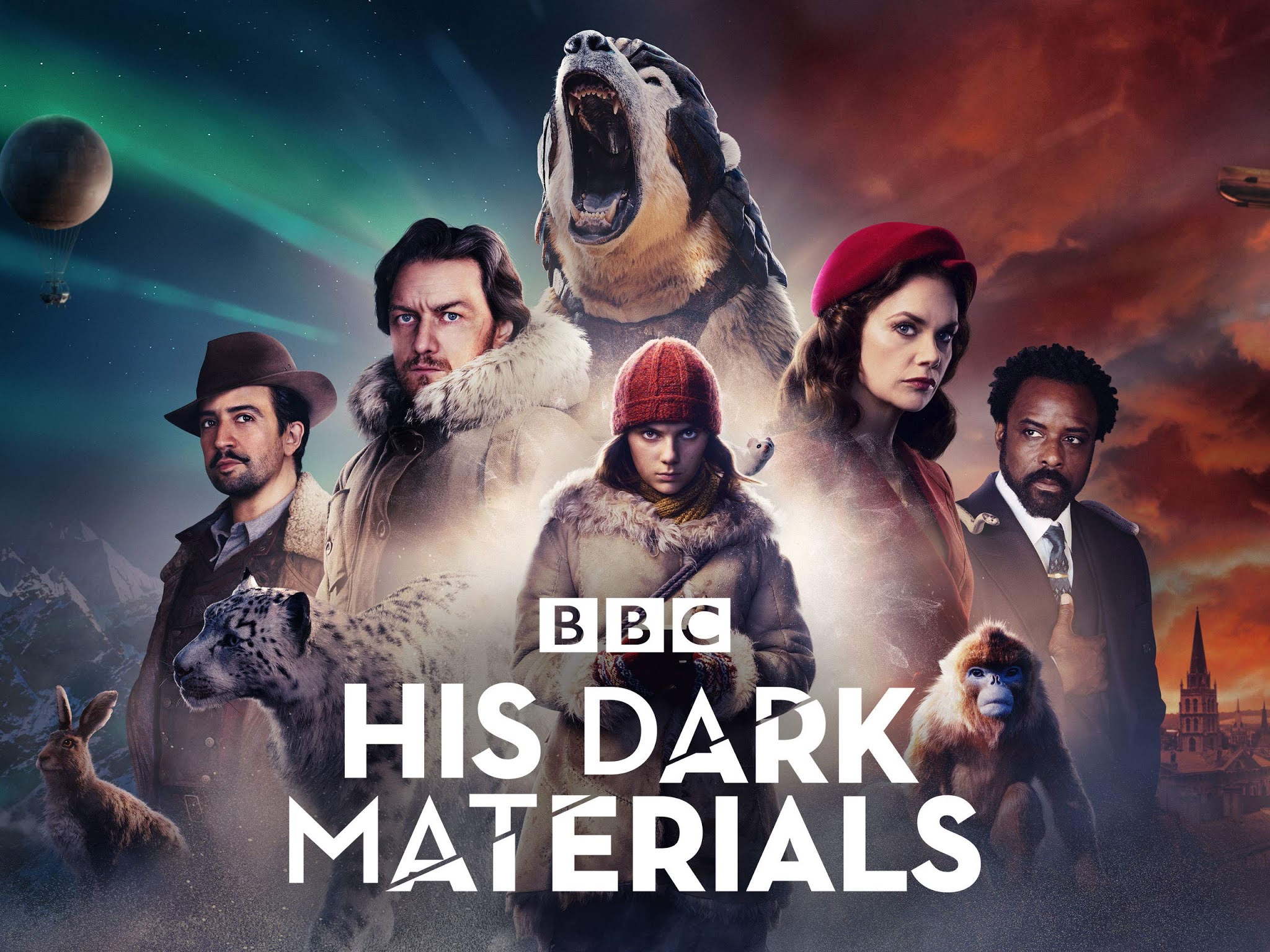
His Dark Materials

I have saved the best until last. This non-Doctor-Who fantasy series, based on the books of Philip Pullman, is a georgeous adaptation, innovative in the way the plot is re-worked for television, and at the same time extremely faithful to the characters, settings and overall story. It's more faithful and more magical than the 2007 movie, and unlike the movie the antiestablishment theme is not diluted. The icing on the cake is the casting and acting - Dafne Keen as Lyra, Ruth Wilson as Mrs. Coulter, James McAvoy as Asriel and Lin-Manuel Miranda as Lee Scoresby.

Monday, 8 February 2021

Eleven Great Sci-Fi and Fantasy Shows On The BBC That Aren't Doctor Who - Part 1

Can you have too much Who?

Even as a lifelong fan of the BBC's flagship sci-fi drama, I'm aware that one of the risks of pouring so much investment and energy in to one show is that it can eclipse other shows, particularly other science fiction and fantasy. So it's worth reminding ourselves that, believe it or not, there are occasionally programmes shown on the BBC channels that aren't Doctor Who. And no, I'm not talking about Torchwood. Here, to prove my point, are eleven BBC sci-fi or fantasy shows that are not even a tiny bit Doctor Who.

I should add that some of the shows here are produced by the BBC, often in collaboration with other networks, while others are produced elsewhere and were broadcast by the BBC thereby demonstrating their excellent taste in programme purchasing. I'll try to make it clear which is which.

This is part 1 of the article. You can read part 2 here.

Good Omens

Adaptation of Neil Gaiman and Terry Pratchet's novel about the unlikely friendship between an angel (Michael Sheen) and a devil (David Tennant) both of whom prefer living on Earth to Heaven or Hell respectively. Co-produced by BBC and Amazon and broadcast in 2019 and 2020, this show is funny, inventive and satisfyingly bonkers, and despite starring David Tennant it is definitely not Doctor Who.

War Of The Worlds

Since H.G.Wells first invented the alien invasion trope there have been rather a lot of adaptations of War Of The Worlds. I have a soft spot for the 1953 movie, and would probably describe the Jeff Wayne musical version as my favourite. I'm less fond of the £2 coin adaptation featuring the four-legged Tripod. I really like the BBC's 2019 miniseries. Instead of setting it in the present day, it's a period drama set in the early 1900s. The story loosely follows much of the novel, but centres on George (Rafe Spall) and his scandalous girlfriend Amy (Eleanor Tomlinson) thereby increasing the number of lead female characters from zero to one. We all know the Martians lose, and how, so a good adaptation of WOTW needs to add something original. This series uses flashforwards to show the aftermath of the war - a world still grieving and still on its' knees many years after the Martian defeat.

Tracks

This might be one of the best things the BBC has ever done. Five series of audio dramas, or if you prefer, fiction podcasts, starring Romola Garai as Helen, a GP who is drawn in to a series of conspiracies after she witnesses a horrific plane crash - and rises to the challenge. Written by Matthew Broughton, each series is an intelligent biomedical thriller very much in the vein of Michael Crichton or Robin Cook.

Missions

Broadcast on the BBC in 2018, this is a sci-fi drama about tech tycoons Meyer and Goldstein, who are not at all inspired by Elon Musk and Jeff Bezos, their privately-funded expeditions to Mars and the surprising discoveries they make on the surface. The series follows Jeanne Renoir (Hélène Viviès), the psychologist trying to keep the crew of Meyer's expedition sane; but as this is a French drama, she must also be having an affair with the married captain.

Dracula

Two out of three ain't bad. A completely new BBC adaptation of Dracula written by Mark Gatiss and Steven Moffat, starring Claes Bang as Dracula, and combining the wit and inventiveness of Sherlock with the sumptuous gothic shenanigans of the Hammer Christopher Lee/Peter Cushing series of movies. I loved the first two episodes, set in Dracula's Transylvania castle and then on board a ship sailing for England, and the rivalry between Dracula and his nemesis Sister Agatha (Dolly Wells) which runs through the series. The third episode which brings Dracula into a completely different setting is a gamble, and I found it less satisfying although there's still a lot to enjoy.

To be continued...


Saturday, 16 January 2021

I'll Take The High Road [Review: Cloudpunk]

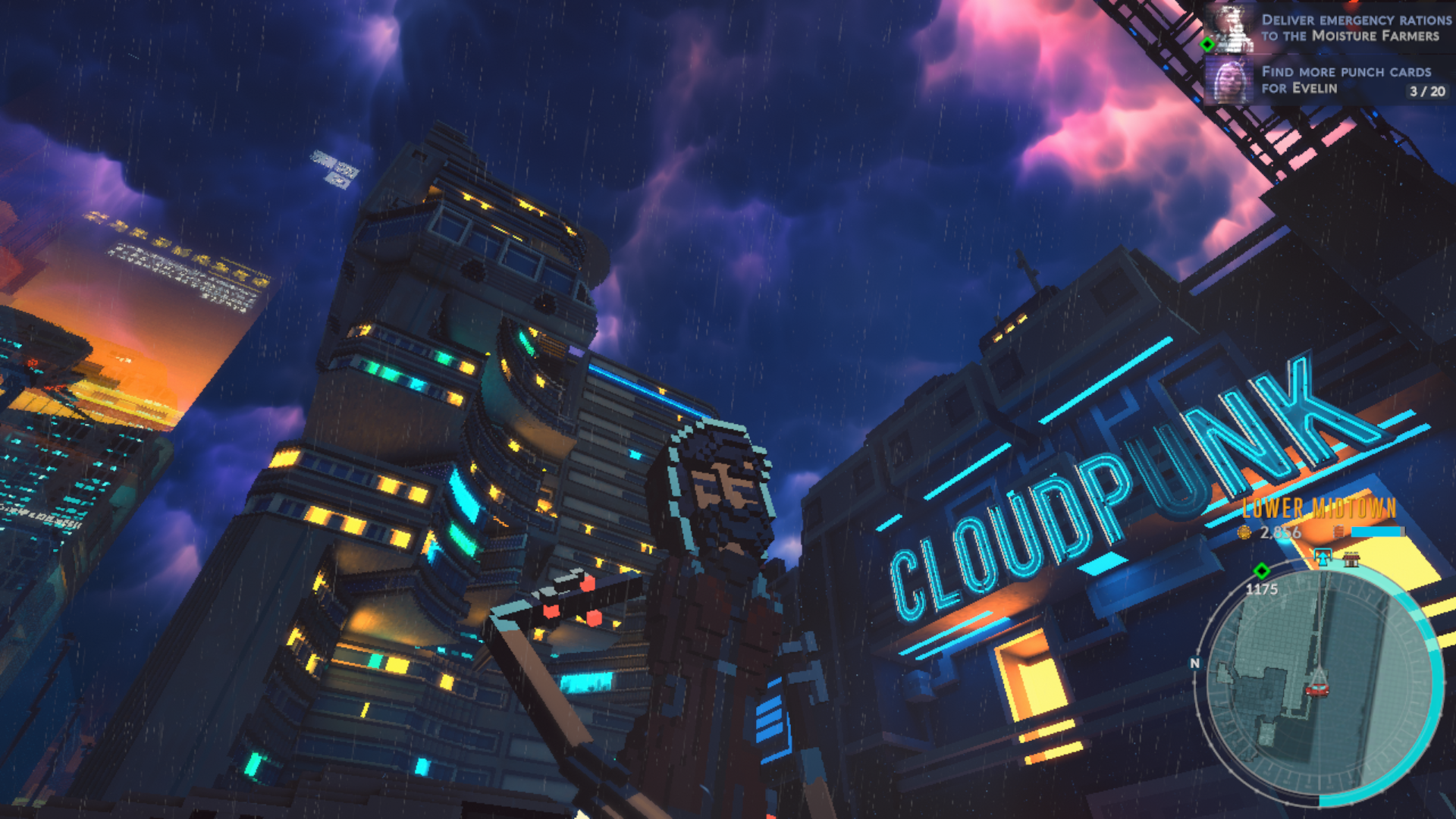
It's a rainy night in Nivalis. You're a recently arrived immigrant and a newly signed-up courier for the slightly illegal delivery company Cloudpunk, delivering parcels to customers around the city guided by the mysterious and melancholy Control. You're penniless and alone apart from your flute and your naive, excitable AI companion Camus the dog. And you have a flying car. It's a cheap pile of junk, handles terribly, and guzzles fuel, but it's still a flying car.

The star of adventure game Cloudpunk is the setting - Nivalis, a massive sprawling neon-infused megacity that you can explore freely in your HOVA or on foot. It's a huge voxellated environment, insanely detailed and full of character. The architecture is extraordinary, and it's alive with activity. HOVAs whip past you along the powered highways or take shortcuts between buildings, and the streets are full of strangers and robots - most minding their own business, but a few who will converse with you, leading to discoveries or side-quests. Even if there were no game element simply exploring the city would be an absolute pleasure. Cloudpunk is basically the game version of every flying car fantasy ever, particularly the neo-noir settings of the Blade Runner films, the Fifth Element or Revenge of the Sith, and it also reminded me strongly of other adventure games I've enjoyed - particularly Omicron: The Nomad Soul, and Anachronox, both of which also feature futuristic cities, free exploration and flying cars.

The main story is told through a series of missions usually taking you from a pickup point to a customer. Rania's conversations with her customers reveal the nature of Nivalis and of this future society, as well as clues leading to a mystery about the city's past. Your meetings with customers are like short stories - you get a brief glimpse of their personalities and lives before moving on to another story.

As a game Cloudpunk is easy. You don't have to learn the Nivalis equivalent of The Knowledge - nav points guide you through Nivalis to your destination. There aren't any time limits on the missions, and there don't seem to be any ways to die or lose - even your encounters with robot gang members and other unsavoury characters don't seem to turn violent. Most of the missions are pretty linear, although occasionally you are offered a moral choice in how you complete them. Fuel this costs money, and you don't earn much as a courier, so getting enough money to buy fuel and repair damage is a challenge, and you'll need to work very hard to upgrade your HOVA or pimp your apartment. Simply flying around the city will eventually use up all your cash, although there are a few alternative ways to make money, such as picking up abandoned items and selling them to merchants.

It's always interesting playing a non-violent game. Again comparing to Nomad Soul's beat-em-up and FPS sequences, they added challenge and peril to the game, but detracted from the story, and often caused frustration when I wanted to continue with the story, explore the setting or just enjoy the David Bowie soundtrack, not repeat the action sequence hundreds of times because it was slightly too hard. Those action sequences could have been removed without detracting from the game - as Cloudpunk proves. Cloudpunk also has a more modern outlook in all aspects of its' writing - Rania often finds herself challenging NPCs about their cultural assumptions and attitudes. And I have been playing for several hours and the plot has not lead me to either a red light district or a strip club - unlike every single other noir-inspired book, movie or game.

To sum it up, Cloudpunk is a beautiful, joyful world to explore, and it's an experience first and game second. While I should be delivering parcels non-stop, it's tempting and equally rewarding just to wander around immersing myself in the scenery and taking selfies.


Sunday, 29 November 2020

You're on mute! [Review: Sleep Dealer]

Sleep Dealer is an indie science fiction movie made in 2008 and set mostly in Mexico. I first came across it when reading an interview with the director, Alex Rivera. I recently watched it online and I think it's a beautiful film, deserving a second lease of life in this era of Zoom remote working.

 Memo (Luis Fernando Pena) is a tech geek growing up in a farming village but dreaming of escape. When catastrophe strikes his family in the form of an aerial drone attack, Memo is forced to leave. He travels to Tijuana, along the way meeting city girl and aspiring writer Luz (Leonor Varela), gets mini-jack ports inserted painfully in his arms and back, and he's ready to get work in a "sleep dealer factory" where he can plug into the VR network and control a construction robot that could be working in another country.

This movie uses near-future sci-fi concepts to tell a very personal story about oppression, exploitation and the value of life. Remote working is not safe - thanks to dodgy electronics Memo runs the risk of blindness or injury every day he clocks in. His employers don't seem to be interested in health and safety and there's little he can do. But while labour is cheap, water is expensive - following the construction of a dam, the rivers around Memo's home village have dried up Jean de Florette style and the inhabitants pay to collect water from a commercially owned and heavily guarded reservoir.

The remote working theme is interesting as it becomes a metaphor for indirect oppression - while the privileged seem to be running the world, the means of oppression are remote controlled checkpoints with machine guns, and their operators are likely to be other low-paid workers. The drone pilot is revealed to be a young American with a Mexican immigrant background and perhaps it is this connection that leads him to seek information about Memo, leading in turn to a surprising finale with elements of Star Wars or Dambusters.

There's also a Scanner Darkly-esque theme about the many aspects of surveillance: Memo and his brother watch the drone attack unfold on a live TV programme, recognizing their own village as the drone approaches its target. Luz pays her bills by literally selling her memories online, including her memories of meeting Memo - a career choice that does not bode well for their relationship.

Sleep Dealer is accidentally prophetic. In addition to the themes of remote working and social media, it's the second indie film I've seen that predicts a US-Mexico border wall. The other is Gareth Edwards debut Monsters. In this case the wall has prevented migrants coming to work in the US, and as a result the low-paid migrant workforce has become an equally low paid remote working workforce, migrating to work digitally all over the world while remaining plugged in to their factories.

As other reviewers at the time of release noted, a weaker aspect of this movie is the CGI for the aerial drones and the construction robots. While it's good enough to tell the story it's not quite convincing as real. In contrast, the practical special effects are excellent. I squirmed in empathic pain when Memo had his nodes inserted - that's one memory I won't be downloading. And the acting from all the lead characters is superb, with total commitment to role.

Overall this is a likeable and thoughtful indie sci-fi and well worth the three stars out of five I'm giving it.


Score: 3 out of 5 stars
All movies reviewed on the Sci-Fi Gene blog are given a score of 3 out of 5 stars.

Monday, 3 August 2020

Shake, Rattle and Roll [Review: Shivers]

Along with Nakatomi Plaza, Peach Trees, Wyndham Tower and the unnamed High-Rise, I have unfortunately had to add Starliner Towers to the list of high-rise buildings to avoid. It's a shame - the period architecture, the peaceful island location and the easy accessibility of the on-site swimming pool, supermarket, medical and dentist's surgeries and parasitology research lab all make it so tempting...

Shivers (also released as The Parasite Murders and They Came From Within) is a horror movie from 1975 directed by the emerging David Cronenberg and set in a tower block in Montreal. Dr. St-Luc is the resident MD tending to the inhabitants who have started to develop odd stomach complaints that are definitely not related in any way to his colleague's work on a parasitic organism designed to replace organ transplants. He is asked to investigate a suicide-homicide that took place in one of the apartments, and discovers a link to the parasites - and the possibility they have already been spread to several other residents through their fun and games.

Taking Shivers out of the context of other films, it's an uneven quality experience and mainly of interest as it shows an early Cronenberg still coming into his powers. Acting is hit and miss, sometimes sincere and convincing, sometimes melodramatic or wooden. Scenes of violence, sex or sexual violence are also variable. A few of these scenes are horribly effective, including the homicide-suicide where an older and sinister man appears to be attacking a schoolgirl, and clips of their fight are juxtaposed with a new couple being shown around the luxury tower-block. 


Other effective horror scenes betray the director's influence by his contemporary George A. Romero as the residents, turned into sex-crazed demi-zombies by the parasite, try to corner St-Luc and nurse Forsythe.  The parasite creature is fun but doesn't ever appear convincing or threatening itself - the most effective creepy scenes are the ones that don't show the creature at all but just its' trails of blood. However the legacy of this film is the continued popularity of parasite-horror, including such classics as Alien (1979), The Thing (1984), Species (1995), The Faculty (1998), the Cronenberg-inspired Slither (2008) and so on. Meanwhile Cronenberg grows in filmmaking ability and his own later films such as Videodrome and eXistenz develop the bio-horror theme further, and the high-rise genre also continues to develop - High-Rise (2015) is essentially a re-make of Shivers without the parasites.


Score: 3 out of 5 stars
All movies reviewed on the Sci-Fi Gene blog are given a score of 3 out of 5 stars.

Tuesday, 28 July 2020

[Review: Thin Air]

Mars - a planet of factions. There are the Western and Chinese settlements, the corporations, the criminal underworld, the political groupings, the various military, police or security organizations... and in the middle of it all is Earthman Hakan Veil, once a unique kind of spaceship security officer, now stranded on Mars, trying to live day to day and find a way to get back to Earth. But someone with Veil's abilities can't stay hidden for ever.

Thin Air is a novel by Richard Morgan. It's unrelated to the Altered Carbon series, and takes place in the same setting as Thirteen (originally published under the title "Black Man") - a few centuries into the future, the Solar System explored and settled, genetic engineering is commonplace, but despite this humans are still as quarrelsome and pugnatious as ever, and boy bands are still a thing.

Veil was engineered from early childhood to be the ultimate deterrent on a spaceship - a hibernating one-man army to be thawed out as a last resort in the event of piracy or mutiny. His abilities come at a high cost - he's a hibernoid, only able to remain awake for nine months before he must find a hibernation chamber, and while "running hot" he has little control over his aggression and lust. Veil is also a relic - the hibernoids have been consigned to history, at least officially. 

Veil's story arc and character are also pleasantly retro. He's the wounded, traumatized tough ex-soldier a la Cormoran Strike and any number of ex-military private investigators, or the special agent with superhuman abilities a la James Bond. The novel reads like a Bond film, with plenty of supervillains, gadgets and femmes fatale to enjoy. At least in Veil's case his ability to handle weapons, vehicles and people is explained by his genetic engineering and AI enhancements - the least credible aspect of the Bond canon is the idea of a competent British civil servant.

Wednesday, 8 July 2020

Wayne's World [Review: Hylics]

Hylics is a role-playing-game with a surreal plasticine vibe. You play the role of Wayne, a man with a plasticine croissant head as he explores his world, meets strange beings, beefs up his stats and prepares to take on an evil plasticine warlord.

At least, that's what I think is going on. The back story is a mystery - you can talk to the many inhabitants of this world with their uniquely shaped heads, but while a few will hint or trade, most will reply in a poetic gibberish.

The plasticine world is equally mysterious and this makes it a baffling pleasure to explore. It's a large, jumbled mess of islands, buildings and dungeons.

There are also villains and monsters to fight. Combat is turn-based and there are a range of weapons to buy, spells to learn and objects to use in battle.

You will die a lot - this is part of the game. Death takes you to a plasticine plateau where you can rest, add hit points and make sandcastles before heading back through the portal and rejoining the fray.

Although Hylics may look like a low-tech 1980s game it was actually written in 2015 by Mason Lindroth.

Wayne can recruit three band members on his travels - literally as it turns out. That's Dedusmuln on the theremin.

Hylics is available at a very cheap price on Steam and will give you several hours of satisfyingly different JRPG gameplay. Just don't expect anything to make sense.


Saturday, 7 March 2020

They're made out of meat! [Review: Tender Is The Flesh]

The spread of a deadly virus leads to the elimination of livestock and animals in general - and to the creeping legalization of cannibalism and a future in which humans are farmed, bred and slaughtered for meat on an industrial scale.

Tender Is The Flesh (Cadaver Exquisito) is a dystopian novel by Argentinian author Agustina Bazterrica. It's told from the viewpoint of Marcos, a senior manager in the "special meat" industry with a role in every stage of the lives of the "heads." Motivated by a need to pay for his father's nursing home and recoiling from his own tragedies and the breakdown of his marriage, Marcos embodies the double-think of the time, taking pride in his expertise and business success while still  aware that he is participating in an atrocity.

There are plenty of bleak, horrific novels in the dystopia genre - not least the torture-heavy 1984 and the misogynistic violence of The Handmaid's Tale or A Walk To The End Of The World. I may have become a little desensitized to literary violence but I rarely read a book that truly horrifies me - Tender Is The Flesh is a rare example of writing that stopped me in my tracks several times, even though I was still compelled to finish reading it. 

It's clear that Bazterrica has far too much time on her hands and has spent much of it figuring out just how modern intensive livestock farming could be modified to farm humans, and all the ways that those on the right side of the electric fences might maintain the sense of denial, from the euphemisms such as "heads" and "special meat" to the scientific "evidence" presented against vegetable diets, to the legal structures protecting and regulating the process, to the removal of vocal cords from farmed humans to prevent them screaming or communicating. The detailed descriptions are shocking, particularly the chapter about 30% of the way through the novel where two job applicants are taken on a tour of the slaughterhouse. And there's still time for interesting subplots - the inhabitants of an abandoned zoo, and the implications that fear of infected bird droppings might be a conspiracy promoted by the umbrella industry.

There's an obvious between-the-lines link to ethical veganism - for those of us who eat meat, are we acting on good evidence that, say, cows are not conscious beings, or are we taking that view in order to make ourselves feel better? Is it our IQ that distinguishes us from the animals - and if so would it be OK to eat a human with lower IQ than a cow?* And what of the Ameglian Major Cow, served at the Restaurant At The End Of The Universe and other fine intergalactic establishments - an artificially created, sentient creature genetically programmed to offer itself up to be eaten on an entirely voluntary, consensual basis. Is that OK?**

But this novel speaks to human-on-human mistreatment too - it's about how humans dehumanize other humans in order to justify tribalism, slavery, racism, misogyny, genocide and so on, and how we give ourselves license to act in this way.

Humanity is broken in this novel - symbolised by Marcos' father, a livestock farmer whose dementia was apparently brought on following the "Transition" to human meat. Marcos and many of his generation are fully aware of the identity of "human meat" - it's an unspoken universal truth rather than a Soylent Green mystery - and they are living with the hypocrisy and cognitive dissonance of treating the "heads" as both human and inhuman, in turn distorting their humanity and morality. Some go for complete "We don't eat people in this house" denial, while others embrace the Transition, such as the game hunters who are equally happy aiming at purpose-bred humans or celebrities gambling their debts on a life-or-death run, or the Scavengers who kill and eat at any opportunity. Marcos is given a chance of a kind of redemption - an opportunity to re-integrate his divided world; the actual outcome reflects just how broken we all are.

*No.
**Still no.

Sunday, 12 January 2020

It only takes a minute girl [Review: Downsizing]


A Norwegian scientist has found a way to shrink humans to approximately 12 inches in height, meaning they have a much smaller environmental impact and incidentally can live a life of luxury on the cheap – but it’s irreversible. Occupational therapist Matt Damon and his wife Kristen Wiig are the couple trying to decide whether moving to a small community is an opportunity worth taking.

There are plenty of movies about shrinking people –Fantastic Voyage, InnerSpace, Honey I Shrunk The Kids, and of course the various appearances of Ant-Man. In all of these movies the shrinking effect is reversible and the tone tends to be a mixture of action and comedy.

Downsizing takes a different approach, the key to which is the one-way procedure which gives miniaturization a whole new meaning. This is highlighted by the shrinking process – no instantaneous shrink ray or Ant-Man suit but a prolonged and demeaning medical procedure involving removal of hair and teeth and injection with a special shrinking medicine before being anaesthetised and locked naked in a giant microwave.

It’s a little hard to describe exactly what kind of movie this is. It’s not an action movie or a thriller, and it’s not a comedy either, although there’s the occasional comic moment. There's some romance, so at least we can be sure that size isn't everything, but it's not really a romantic comedy either. Perhaps it’s a little confused – too many subplots with messages about environmental catastrophe, race, immigration, poverty, social inequality and division.

However this is first and foremost a science fiction story in the John W. Campbell sense – the downsizing is the only fantasy element, and the movie takes this concept very seriously and explores the consequences, good and bad, of this new technology and its impact on the world. The result is a thoughtful movie about the challenge of taking an irreversible step into the unknown, and how this affects relationships in which some decisions are reversible.

While most of the supporting cast are poorly developed to the point of stereotyping – flamboyant European party animal, immigrant cleaner with heart of gold and so on, Matt Damon’s lead character is the exception – he’s got enough of a backstory and personality to convince that he is not a hero or villain but a likeable Philip Dick-style everyman character trying to muddle through.

Downsizing is a B-movie, and it’s disappointing in places but occasionally thoughtful or touching. It’s been mis-promoted as a comedy in the trailers when it would be better described as a drama. I found enough positives to merit the highly coveted Sci-Fi Gene three-star rating.

Score: 3 out of 5 stars
All movies reviewed on the Sci-Fi Gene blog are given a score of 3 out of 5 stars.

Monday, 25 November 2019

The Empire Strikes Flatpack [Review: Aniara]

The space cruise ship Aniara begins its three-month mission to bring thousands of moderately rich Earthlings to Mars, leaving behind an environmental catastrophe. Amongst the passengers is MR (Emelie Jonsson), a technician responsible for tending to MIMA, an AI that can give the colonists soothing visions of Earth before the disaster. But shortly after departure a collision leaves the Aniara drifting off course with no engine, challenging Captain Chefone (Arvin Kananian) and his crew to try to find a solution and keep the passengers happy.


Aniara is a Swedish-Danish movie – and you can tell this as it takes place on the decks of a rectangular cruise ship clearly designed and built by the Ikea-Lego Corporation (Assemble Your Own Better Worlds). There’s some clever low-budget sci-fi filmmaking – the interior of the Aniara has been filmed in airports, shopping malls and hotels, or perhaps airport shopping malls and hotels. CGI is sparsely used, basic but effective, mainly limited to exterior views of the drifting Aniara.

The Aniara. Slightly rippled with a flat underside.

Aniara is based on the famous epic poem by Swedish Nobel prize winner Harry Martinson, which as well as this 2018 movie has also inspired an opera and several obscure albums in musical styles from jazz to metal. The original poem incidentally is subject to disgraceful anti-English discrimination. While the Swedish, French, Japanese and Spanish editions are all on Kindle for under £14, Sjoberg’s English translation starts at £117 in paperback only. And this isn’t even the most depressing thing about the poem.

Emelie Jonsson carries the film, playing MR as a character determined to be happy and optimistic, to persevere and to see the best in others. She believes in love and kindness. She’s perhaps a symbol for the human spirit. While other characters, such as MR’s roommate the astronomer, swing constantly between positivity and negativity, it takes a lot to bring MR down, and when this happens it is painful.

Beautiful but misleading poster for Aniara. While the woman in the centre is MR, the main character in the film, she generally looks happier than this. However she does occasionally look over her shoulder. The spaceship in the foreground is not the Aniara and indeed is never seen in the movie, and I don't recognize the coridoor behind MR's head either.

I loved the economical and atmospheric setting, and the contrast between MR’s optimistic naïveté and the growing despair of the Aniara society. Will hope triumph over darkness? I won’t give away the ending but I repeat, this is a Swedish-Danish movie. The movie is divided into years of the voyage, with each year bringing new, sinister developments. It’s bleak – only three years into the voyage there appears to be a line-dancing revival, and things go downhill fast from there. The film ends not with a traditional Hollywood bang but an indie Scandinavian whimper, which is in keeping with the tone and story but may disappoint some.

Aniara is a deliciously dark indie sci-fi drifting in the direction of three stars.


Score: 3 out of 5 stars

All movies reviewed on the Sci-Fi Gene blog are given a score of 3 out of 5 stars


Sunday, 1 September 2019

Fantastic Beasts And Thra To Find Them [Review: Dark Crystal episode 1]


The world of Thra is changing. The Skeksis, alien vulture-like creatures who have ruled over the native Gelflings for hundreds of years, have plundered the power of the Crystal to sustain themselves, and this is beginning to influence Thraian lifeforms in sinister ways. Most of the Gelflings are extremely gullible and view the obviously evil Skeksis as benevolent lords, but one or two are beginning to smell a rat. Junior guards Rian (Taron Egerton and Neil Sterenberg) and Mira (Alicia Vikander and Helena Smee) are searching the Skeksis castle for an escaped Spitter when they have an unfortunate encounter with the Skeksis chief scientist; meanwhile Gelfling princess Brea (Anya Taylor-Joy and Alice Dinnean) becomes suspicious of the tributes offered to the Skeksis lords during the annual tithing ceremony, and underground-dwelling Deet (Nathalie Emmanuel and Beccy Henderson) discovers that her favourite baby nurloc has become a little irritable. Something isn't quite right.

Set before the events of the 1982 movie, The Dark Crystal is a new TV series produced by the Jim Henson company and available on Netflix. Like the movie, it's an ambitious attempt to tell an epic science fiction story through puppetry - the cast, and the many forms of wildlife on Thra, are all portrayed by puppets. However this is not an anti-CGI campaign but a pairing of visual and special effects, with live-action puppetry transported to a computer generated landscape.

Thra is a planet rich in fantastic beasts, and they have been created with imagination and humour - this is one of the most enjoyable aspects of the episode. Imagine Avatar re-created by the Muppets. In fact there are plenty of similarities between Pandora and Thra. Both ecosystems have been imagined in great detail, and there does seem to be a lot of bioluminescence about on both planets.

The first episode has to introduce the planet's backstory through a brief history lesson, introduce the many Gelfling factions, and begin the stories of the Gelflings and Skeksis central to the plot - as a result the action switches from region to region rather like an episode of Game of Thrones. And without providing too many spoilers, as with Game of Thrones maybe you shouldn't get too fond of any particular characters.

Speaking of characters, each major role in Dark Crystal is credited to two people - a voice actor and a puppeteer. The voice cast is stellar - see examples above, but the list also includes Mark Hamill, Simon Pegg, Sigourney Weaver, Helena Bonham-Carter, Killjoys' Hannah John-Kamen and a few Game of Throners for good measure. Look at the full cast list on IMDb here and weep. I haven't heard of any of the puppeteer cast but I now wish I had - they are incredibly talented.

Conclusion: a strong first episode that provides exposition, starts off several plots, introduces characters and gives some idea of just how epic this series could be. The rest of the series has much to live up to.

Tuesday, 13 August 2019

The Only Whale Is Essex [Review: White Space]

Space... the final food frontier. These are the voyages of the starship Essex, it's continuing mission to explore strange new worlds, to seek out new life and new recipes, to boldly eat what no man has eaten before.


White Space, also released as Beyond White Space, is a 2018 sci-fi movie. It is the future, and mankind has taken up space fishing. Captain Richard Bentley (Holt McCallany) commands the starship Essex and its dysfunctional, squabbling and unfeasibly good-looking crew. Their mission: to catch space-crabs (these are giant, edible asteroid-dwelling creatures actually called Clickers, not some sort of space STD) under the watchful eye of inspector Navarro (Zulay Henao). However Bentley's father perished seeking Tien Lung, a legendary dragon-like space creature, and Bentley is obsessed with revenge. Yes, this is another sci-fi take on Moby Dick. And no, this is not going to end well.

The best aspects of White Space are the ship and the crew. The Essex is well designed inside and out, it has character - part submarine, part trawler, it's dark and atmospheric, there's plenty of blue lighting which is important in sci-fi, and by the end of the film you can feel reasonably familiar with it. Is it named after my home county of Essex, England, famed for its orange lifeforms? Or for the various towns or counties also called Essex in the US? Perhaps it was named after David Essex, who finally receives the acclaim he so deserves for the song "A Winter's Tale" in the 22nd century. We will never know. The visual effects are great for the various spaceships, a little less great for the creatures.

I enjoyed getting to know the crew - interesting characters and interesting relationships, although Hawthorne (Mike Genovese), the marinated ancient mariner, is a bit of an annoying cliché. The cast are relative unknowns, at least to me. Perhaps I should get out more.

I actually think this film would have been better if it had just focussed on the captain and crew with their various obsessions, and let their tensions, arguments and misbehaviour go even further - but instead the writers throw in such highly original elements as Space Pirates (TM)! and a Parasitic Life Form (TM)! which add little and get in the way of the story.

White Space is a decent B-movie, and as Moby Dick sci-fi adaptations go I found it more enjoyable than 2010: Moby Dick. It gets enough right to be watchable despite its flaws, and manages to reel in a leviathan 3 stars out of 5.

Score: 3 out of 5 stars

All movies reviewed on the Sci-Fi Gene blog are given a score of 3 out of 5 stars