Showing posts with label game. Show all posts

Saturday, 16 January 2021

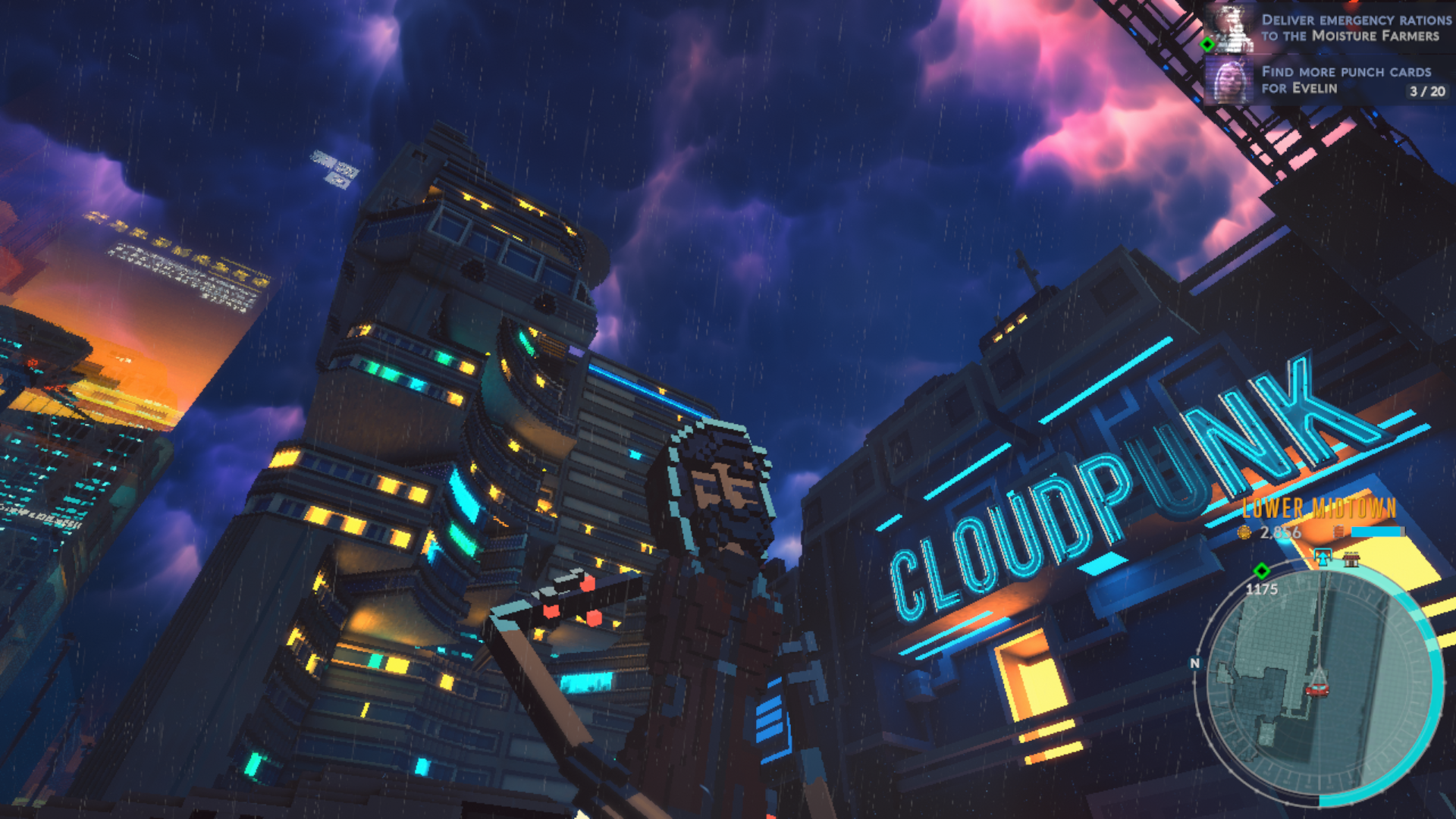
I'll Take The High Road [Review: Cloudpunk]

It's a rainy night in Nivalis. You're a recently arrived immigrant and a newly signed-up courier for the slightly illegal delivery company Cloudpunk, delivering parcels to customers around the city guided by the mysterious and melancholy Control. You're penniless and alone apart from your flute and your naive, excitable AI companion Camus the dog. And you have a flying car. It's a cheap pile of junk, handles terribly, and guzzles fuel, but it's still a flying car.

The star of adventure game Cloudpunk is the setting - Nivalis, a massive sprawling neon-infused megacity that you can explore freely in your HOVA or on foot. It's a huge voxellated environment, insanely detailed and full of character. The architecture is extraordinary, and it's alive with activity. HOVAs whip past you along the powered highways or take shortcuts between buildings, and the streets are full of strangers and robots - most minding their own business, but a few who will converse with you, leading to discoveries or side-quests. Even if there were no game element simply exploring the city would be an absolute pleasure. Cloudpunk is basically the game version of every flying car fantasy ever, particularly the neo-noir settings of the Blade Runner films, the Fifth Element or Revenge of the Sith, and it also reminded me strongly of other adventure games I've enjoyed - particularly Omicron: The Nomad Soul, and Anachronox, both of which also feature futuristic cities, free exploration and flying cars.

The main story is told through a series of missions usually taking you from a pickup point to a customer. Rania's conversations with her customers reveal the nature of Nivalis and of this future society, as well as clues leading to a mystery about the city's past. Your meetings with customers are like short stories - you get a brief glimpse of their personalities and lives before moving on to another story.

As a game Cloudpunk is easy. You don't have to learn the Nivalis equivalent of The Knowledge - nav points guide you through Nivalis to your destination. There aren't any time limits on the missions, and there don't seem to be any ways to die or lose - even your encounters with robot gang members and other unsavoury characters don't seem to turn violent. Most of the missions are pretty linear, although occasionally you are offered a moral choice in how you complete them. Fuel this costs money, and you don't earn much as a courier, so getting enough money to buy fuel and repair damage is a challenge, and you'll need to work very hard to upgrade your HOVA or pimp your apartment. Simply flying around the city will eventually use up all your cash, although there are a few alternative ways to make money, such as picking up abandoned items and selling them to merchants.

It's always interesting playing a non-violent game. Again comparing to Nomad Soul's beat-em-up and FPS sequences, they added challenge and peril to the game, but detracted from the story, and often caused frustration when I wanted to continue with the story, explore the setting or just enjoy the David Bowie soundtrack, not repeat the action sequence hundreds of times because it was slightly too hard. Those action sequences could have been removed without detracting from the game - as Cloudpunk proves. Cloudpunk also has a more modern outlook in all aspects of its' writing - Rania often finds herself challenging NPCs about their cultural assumptions and attitudes. And I have been playing for several hours and the plot has not lead me to either a red light district or a strip club - unlike every single other noir-inspired book, movie or game.

To sum it up, Cloudpunk is a beautiful, joyful world to explore, and it's an experience first and game second. While I should be delivering parcels non-stop, it's tempting and equally rewarding just to wander around immersing myself in the scenery and taking selfies.


Tuesday, 20 October 2015

Dystopia City - final version [Scratch game]

This is the final version of my Scratch game Dystopia City - with thanks to Scratch users E1eventeen and alpacaceratops for their comments and to everyone who played the beta. I've tweaked the gameplay, instructions have been re-written, there's a soundtrack composed in MuseScore, a better menu system and six alternate endings.

Grateful thanks to Freesounders leuphana, nathan-lomeli, samararaine, medialint, lebcraftlp, hunter4708. Thanks also to the makers of Blender and MuseScore.

Instructions:

Scroll map - Up and down arrow keys

Build - click to move the build cursor, choose a tunnel from the Build Tunnel menu or use hotkeys: C=coridoor E=elevator V=clone-vat O=office L=life support

Assign Roles - choose a Faction from the Faction-Role menu, then choose a Role to assign to that faction: Construction, Repair, Paperwork or Firefighting. For example if you choose Hufflepuffs and Paperwork then all Hufflepuffs will be assigned to do Paperwork whenever they are near an Office. At the start, all Factions are assigned to Construction.

Clonevats produce cloned citizens. Offices make money through Paperwork. Life Support produces food/oxygen/water for 10 citizens. When these tunnels break down, assign a Faction to the Repair role.

Increase the population of the Citadel to 150 to win. Keep your citizens occupied to prevent boredom - bored citizens will start to light fires or try to break out of the Citadel. You can turn the music score on and off by clicking the music button. Hint: it's not a bad idea to start by building an Office then assigning one Faction to Paperwork.

Tuesday, 13 October 2015

Scores on the Doors [Work in progress: Dystopia City]

Nothing says dystopian future like a double bass...
Working on a final version of my Scratch game Dystopia City - will be ready for release very soon. I've made a few tweaks to gameplay, re-written the instructions, added a few more alternate endings, and I'm working on a score in MuseScore.

Friday, 25 September 2015

Dystopia City - Playtesters Wanted


Update 20.10.2015 - this is the beta version. I've since returned to this game and made some changes to gameplay, taking into account comments by beta-testers. I've re-written the instructions, added a better menu system, a soundtrack and there are now six alternate endings. You can play the final version here.

Thursday, 24 September 2015

Far Out Man [Review: Out There]

Those human pilots! If they're so keen to make their way back to Earth, why do they keep getting themselves warped away from it?

Out There is a neat little space opera for Android and iPhone. You wake from cryosleep to discover your spaceship has been 2001'd into an unfamiliar galaxy. Hundreds of star systems away, you are aware of a particular star that may be important, but your first task is not to die. 

The game is turn-based and there's no combat. Well, that's not quite true. There is an enemy to discover and there is in fact a way to attack enemy fleets. But mostly, you choose the next planet or star, decide whether to land, whether to drill for resources, whether to meet the local species, whether to take over the abandoned spaceship etc. It plays a lot like a Fighting Fantasy gamebook - I have fond memories of Starship Traveller. It's also really, really hard. This is a survival-themed game - meaning you will die a lot. You can die by running out of hydrogen fuel, oxygen, or iron to patch up your hull, any of which is easy to do.

You stay alive by mining or scooping fuel, oxygen or iron from various worlds - along the way encountering aliens, discovering plans for technology to mod your ship, and experiencing random hazards and events. But as your ship only has limited storage space, and planets only yield a small amount of elements, it's hard to keep up stocks. If you've discovered a mod, you still need to mine the right elements to build it, and then it takes up even more of your hull space.

The map is random, as are many other game features, and when you die it's back to the start with a new map. However, if you're careful you can learn more about the game each time you die, and try out different strategies to survive for longer. As the game progresses, more "important" stars appear on the map, but so far I've only ever made it to one of them without dying. This is an extremely difficult game but one I've enjoyed exploring.

Saturday, 19 September 2015

A Lack Of The Clones [Work In Progress: Dystopia City]

Dystopia City is taking shape: I'll release a beta version soon. I had originally planned the game around the task of growing your population of cloned Citizens to 500 - but while playtesting, as I approached a population of 200 other parts of the game started to break down. As well as the Citizens themselves, who are clones in both the Scratch sense and the literal sense, I also use cloned sprites for my scrolling map, for fires and for some of the effects and menu options. A response from a helpful Scratcher on the forum confirmed my suspicion that the number of cloned sprites Scratch can handle is limited to 301.

Factions of Dystopia City

I've re-weighted the game based around a lower total population. Now working on the various possible endings, and thinking about sound effects and possibly music...

Monday, 10 August 2015

Queen Elizabeth I's Execution Confusion [Scratch game]


Something different: my first Scratch-programmed game, inspired by what may be history's worst ever paperwork nightmare - that occasion when Queen Elizabeth I accidentally signed the death warrant for Mary Queen of Scots, as it was mixed up with all her other documents. I know, happens to me all the time. At least, that's her story - while it's frankly a rubbish excuse for an execution, it's a great excuse for a game...

As your ministers place their warrants before you, sign those deserving of death with your quill, - but beware! beheading the more popular celebrities of your reign will dent your popularity, so make sure you don't sign them, and some treacherous ministers might try to trick you into signing your own warrant.

Remember to dip your quill in the inkwell whenever it runs out.

Although Scratch is a fantastic BASIC-style programming system, for the moment it is Flash-based which means PC only. Apologies to Apple users - but hopefully there will be an HTML-5 version sometime.

Friday, 7 August 2015

Dig For Victory [Review: Waking Mars]

"Amani, this is Liang. I've been exploring these Martian caverns for ten hours now and I'm reaching a conclusion about the nature of this game. The discovery of a smooth-walled vertical cavern running through many layers of the map confirms my hypothesis: this is not a naturally occurring structure but a tribute to the classic BBC Micro era game Exile."

Waking Mars is a game for mobiles, tablets etc. with impressive scope. As astronaut Liang, you explore a network of caves with your jetpack, searching for a missing robot and discovering an ancient ecosystem as you go. In order to progress, you'll need to understand the relationships between the different life forms (your computer assistant, ART, is keen to point out that they are not technically plants or animals), and use this knowledge to increase the biomass in each area.


Gameplay video by Youtube user 1Retrodroid

The gameplay area is huge, and after you've taken the first few steps the game becomes non-linear, allowing open exploration and free travel between areas of the map you've visited. There's something new to discover in most zones, and plenty of memorable moments. The non linear play also means it's possible to "complete" the game, reaching one of the alternate endings, without making all the possible discoveries, and different players will have different experiences. That said, in about 15-20 hours of play I think I was able to explore the entire map and as far as I know I have found all the discoveries and possible endings.

Physically the game plays like Exile in terms of exploring a 2D cave system by jetpack, avoiding hazards such as molten lava, rockfalls and some of the more vicious plants. However the game mechanism of solving puzzles through planting seeds and managing ecosystems - third person gardener? grow-em-up? - is perhaps unique. I love the fact that while some puzzles are scripted or set up, some arise naturally from your own actions and mistakes. You can introduce a species of plant to an area that rapidly colonises and kills other species, and regaining control can be hard work.

There's some decent characterisation too. Liang, your character is cynical and prone to silence. He is assisted from base by Amani who is much more chatty and open minded, leading to some great Mulder-and-Scully banter. ART provides a comic element - he communicates through smiles (a little like GERTY) and suffers from a malfunctioning language module, as well as a habit of stating the obvious.

For comparison, gameplay video of the original Exile (BBC Master version) with comments by YouTube user Lord Triax

It's good to see that epic computer games are still being made, even if mobile gaming as a whole is skewed towards casual games. Yes, Crossy Road, I'm talking to you. There have been other exceptions - I previously reviewed the excellent Deep: Submarine Odyssey here - and of course there are newer gameplay styles such as Minecraft that reward longer play in different ways.

Saturday, 31 December 2011

Arco Warriors [Review: Cyberlords Arcology]

Cyberlords is a sci-fi RPG playable on mobile devices. Jesse, an inhabitant of the Asgard Arcology megacity, wakes up in a clinic owned by the sinister McCoy corporation. Is Doctor Who in charge of this dystopic future? Or perhaps it’s the crisps. For a moment I thought Jesse might even have lost his memory but thankfully the cliché police did not have to be called, and soon Jesse is receiving cryptic messages, from an artificial intelligence, that might help him to escape and contact the resistance. He can then tool up, recruit some thugs and hackers, and carry out a series of missions to uncover the secrets of the Arcology and the McCoy corporation’s sinister plans for its population.

I’m loving this game with it’s eight-bit style 2D graphics, simple colours and copious blood and guts, all reminiscent of the ancient classic Syndicate. As far as the RPG side goes, the playing area is large and divided into many zones and levels. You assemble a group of four player-characters, each with a little bit of personality and backstory. Sadly there’s no choice about who you recruit. There’s also a Deus Ex style system of cyber-upgrades - find the blueprint, bring it to the Resistance doctor for implantation, then trade your experience points for further upgrades. Implants might improve your stamina, speed or accuracy, or give you the ability to regenerate or hack into robot guards, but some are a bit too far fetched - one even allows a character to use both hands simultaneously!

There are story and side missions most of which are combat heavy, and some of which will send you across the playing area and back again. It helps that the control system is reasonably good with one-touch or two-touch routes to almost everything you want to do, although it’s slightly awkward if your four characters are too close together. Minor issues aside, Cyberlords is a stylish and satisfying RPG and another proof that complex gaming experiences can be provided on a mobile.

Tuesday, 15 September 2009

Here I am, brain the size of a planet [Review: Mental Repairs Inc.]

This is the website description of Renzo "Eshaktaar" Thönen's game: "Mental Repairs, Inc. is a 2.5D point'n'click adventure that puts you into the shoes of Henrik Liaw, machine psychiatrist. Henrik's unusual..." by this time I had stopped reading and hit the download button.

Mental Repairs, Inc. is an indie game built on the Wintermute Engine. Liaw, who doesn't look nearly old enough to be a medical student let alone a psychiatrist, is called out to a company HQ where the mainframe computer has malfunctioned. However before he can even reach the mainframe he has to deal with a number of disturbed appliances including (genius) a lift with multiple personalities, one of whom only wants to go up. Another nice touch is Liaw's PDA device which acts as a hint system and plays an integral part in the plot - but also has it's own character and a tendency to make jokes about Eliza or Turing Tests. The whole scenario is a little reminiscent of Douglas Adams' work, which is populated by manically happy sliding doors and eccentric robots including of course Marvin - who would seriously benefit from a few sessions with Henrik Liaw.
As this screenshot shows, although there are a small number of locations they are detailed, stylish and atmospheric.

The best compliment I can give this game is that it is much too short. I completed it in a few hours of gameplay over three days, and was left wanting much, much more. The gameplay around healing neurotic machines and computers works well, particularly in the first act (the second act tries to do something a little more metaphysical), the interaction with each appliance is different and well thought-out. The puzzles are both logical and consistent with the story, and the idea strikes a real chord - I've yet to see an office computer system, for example, that isn't at least a bit neurotic. So it would have been good to see this game extended, with more appliances to heal.

Monday, 3 November 2008

From Homeworld to Turner

If you're looking for inside gossip on films or games still in production, or secrets of the Lost spin-off (working title "Ah, there you are again - had me worried") you may or may not be disappointed by this column - if so, just type "sci-fi blog" into Google. If you want acerbic, contrary and offensive yet brilliant film reviews read Mutant Popcorn, found in Interzone magazine. Because I have the sci-fi gene deficiency, I am rarely disappointed and will usually find a retrospective justification for enjoying just about any film. I almost never take a strong dislike to anything (but more about "Kate and Leopold" another time.)

I wanted to mention Homeworld, an old PC war game. This was welcomed with seriously good reviews and awards on its release but is now old news. What I wanted to point out was, apart from the simple gameplay and smooth interface, I was awe-struck by the graphics - despite polygon counts and texture densities so low you could run this game with only (only!) an 8-bit graphics card, the game conjured up images of spaceships that could easily fit on the cover of a Golden Age paperback.

Which leads neatly to the topic of cover art: science-fiction readers more than anyone else should avoid judging a book by its cover - basically because the covers are so good. Here's Alien Way, a book I enjoyed greatly while being fully aware of its lack of any merit whatsoever (oh God not another power-crazed misunderstood anti-hero). The cover shows a vast wrecked hulk of a starship, towed by a smaller, sleeker ship. Unusually, the scene actually relates directly to an event early in the book - a wrecked human ship recovered and towed to an alien homeworld.

I don't even know the artist - as in those innocent days the artist didn't even get a mention in the book. The composition reminded me of something, and a few Google searches later I found it - Turner's "Fighting Temeraire" depicting the decomissioning of a sailing ship, towed by a steam-powered tug, symbolizing the end of the Age of Sail and the rise of new technology - this is appropriate given the book's theme of the conflict for supremacy between two intelligent races.