Showing posts with label computer game. Show all posts

Tuesday, 10 September 2024

Tracks Of My Tears [Review: Honkai Star Rail]


I've always enjoyed RPGs and other games with a strong open-world component, where there's a sense that the world is much bigger than the game, that events are unfolding everywhere whether you are there or not, and where you can choose to follow the main game arc, explore, dive into the lore or the social buzz, or take a break and enjoy the scenery. Games such as Omicron:The Nomad Soul, Anachronox or Cloudpunk have been particular favourites.

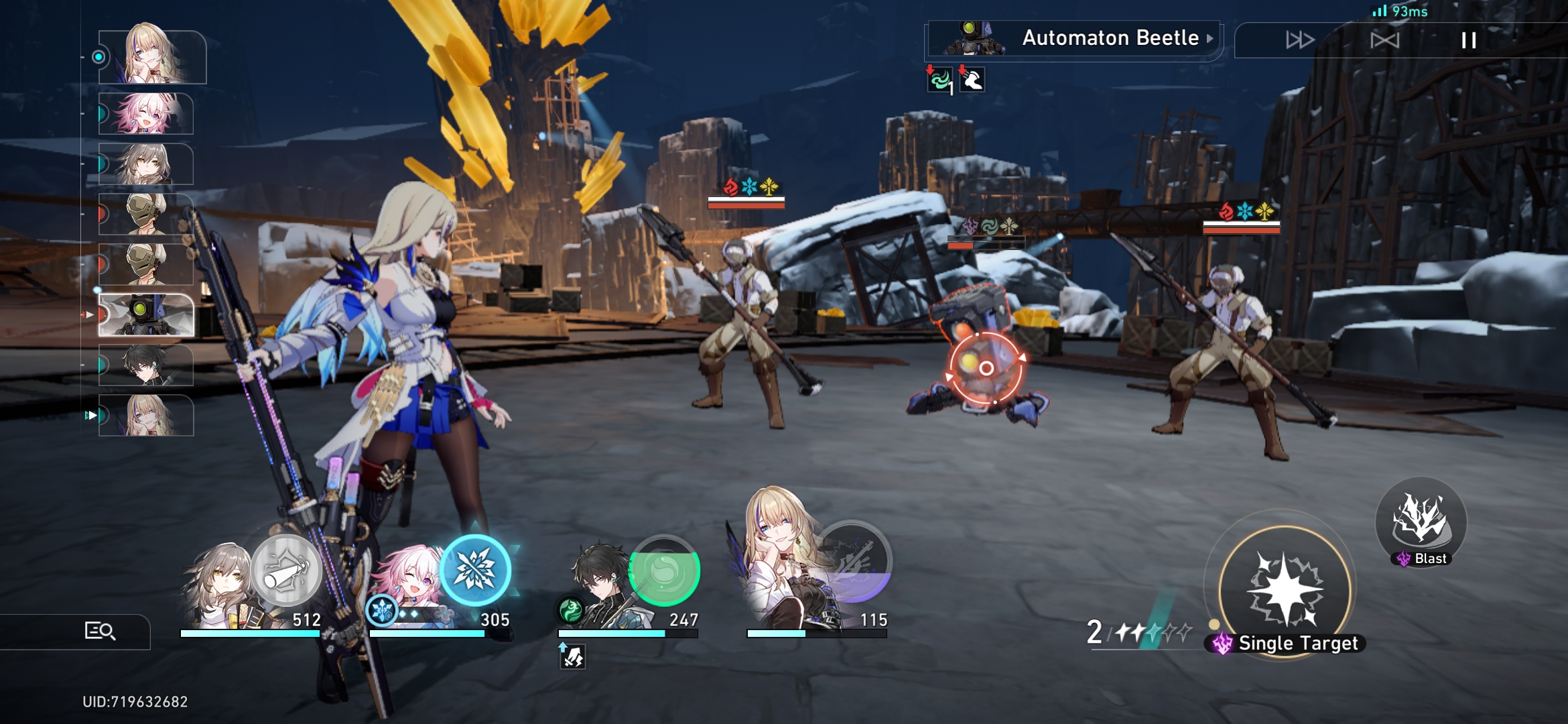
Honkai Star Rail is another such game. It's a Chinese RPG, although very much in the JRPG style, and is indirectly linked to Genshin Impact and other Hoyoverse games through a kind of multiverse setting. The plot revolves around the hero, a character apparently created to contain a dangerous object called a Stellaron. Following the first missions, set on a giant space station, the hero joins the crew of the Astral Express on its interstellar mission to stop natural disasters caused by other Stellarons.

Like Anachronox and many role playing games, Star Rail involves turn-based combat, with your party of adventurers choosing whether to use their attacks, skills or ultimate moves. As the game goes on you can build up a larger group of characters so you can select which four suit a particular battle. I'm learning which characters work best together and how to activate certain characters' extra attacks or abilities.

It's also ridiculously complex - so far I've found at least six different ways to power-up your characters and develop their abilities. 

Characters follow the paths of Aeons (ancient god-like entities) - this acts a bit like a character class in D&D and decides some of their strengths and abilities. It is possible for characters to change path.

You can also power up your characters with individual experience points, Trailblaze experience points (whole team experience), Light Cones (an individual ability boost), Traces (a kind of tech tree for each character that can enhance their different skills and attacks), Relics (basically armour - masks, body armour, boots etc) and Eidolons (possibly recovered memories that, once earned, add to the character's stats). Light Cones and Relics can themselves be upgraded as well. There are also temporary boosts such as food items.

All clear?

Following the missions in the main story arc will bring you into combat against gradually more powerful enemies, but there are also plenty of non-combat missions. I was surprised to find that, having defeated the big enemy in the second major chapter of the story, I was then sent on a series of missions to listen to the new mayor give speeches, visit all of my newfound friends to say goodbye, and take selfies in all the locations I'd visited, before I could progress to the next chapter. Is this normal for computer games now?

There are also more side quests than you can shake a stick at. Characters in the game will call or text you, with conversations that often lead into invitations or errands, while simply exploring the various cities and talking to inhabitants can also lead into missions. There are daily missions and challenges too - it's actually quite overwhelming, but it does give that sense that you are part of a wider world. If you just want to fight monsters, whether to gain experience or materials for crafting, or just for fun, there are several different types of location where you can do this.

As the difficulty of the main story arc gradually increases I am increasingly finding that I have to abandon it, do a whole load of missions, fights, crafting and upgrading before I can return with stronger characters.


Star Rail is fairly child friendly. It's vague about death - fights take place in a kind of combat zone, and monsters often appear to be banished to some other universe rather than killed, while humans and other sentient characters are usually defeated rather than killed, even if they appear to be blown apart in the combat. There's a lot of friendship, but only hints of romance between any of the characters. 

The world of Star Rail is large, and it expands as you play - each chapter in the story arc is set in a completely new world or space station, each with its own cities or zones. Most of the time you are free to follow the plot missions or leave them behind, teleport freely between different locations and pursue other missions or activities. Each region is distinctive and there's plenty of interesting places to go.


Many aspects of Star Rail prioritize gameplay over realism. It is a game after all. For example, the ability to teleport anywhere, leave one mission behind and follow another, gives a great sense of freedom, but takes away a sense of urgency for the main story missions. It also means the Astral Express itself isn't required for travel, except at the start of each chapter when it brings you to a new location. You can also bring a line-up of any characters you have recruited into a battle - so they can be different from the characters actually present or involved in the mission. Each character has their own attack style and animations, from regular baseball bats, swords or spears to giant chickens and energy-blasting guitars. This is not hard sci-fi.

Star Rail has several play-to-play aspects. However I have been playing for free, without any in-game purchases, and so far I haven't felt disadvantaged or excluded.

A good test of an RPG (for me!) is whether the player warms to the characters and feels invested in their stories. Star Rail passes this test well, at least for several of the main playable characters and NPCs. Overall Star Rail is a fun open-world RPG with enough scope, depth and story for me to lose myself in it for a while longer.

Tuesday, 14 August 2018

BASICally speaking

A long time ago, before blogging was a thing, the Sci-Fi Gene has fond memories of learning to program on an early home computer, the BBC Model B. My efforts were written mainly in BASIC IV, with only a few very minor excursions into machine code. They were stored on C90 cassettes and later on 5" floppy disks - buying the double-sided disk drive was a major life event.

Most of my games and other programming experiments would be of interest only to myself. However one or two made it to the pages of user magazines and their monthly giveaway disks, and a few appeared on public domain lists. I was recently surprised to find that some of these games have been preserved at the Complete BBC Games Archive here - where they are playable online!

I present the games here not because they're particularly good - they're not, they're basic, derivative and barely playable - but because they're part of my journey and experience of the digital world, and because as a geeky teenager I learned a lot by writing them. The challenge of cramming a game into such limited memory (32K, minus anything from 1K to 20K for screen memory) and the limited graphics meant you had to try to be creative.


"Break Down"


"Supersonic Snail Racing"


"Myriapod"


"Telephone Mania"


"Space Detective" (apparently, in the future the word "apartment" is spelled differently)


"Wallaby Wrestling Federation"
Please note that no simulated wallabies were harmed in the making of this game.

Over the years I've experimented with other programming languages including Inform, C and Python as well as other BASIC-based languages including Scratch. I've come to realise two facts: firstly, I'm never going to be the next David Braben, and secondly, my brain's native language appears to be BASIC.

With thanks to the BBC Games Archive, and all who are responsible for maintaining it.

My games are playable here. Thank you for joining me on this pleasantly indulgent trip to nostalgiopia.

You can reach the main archive here. It's an extraordinary collection of full commercial releases - including classics such as Elite and Exile - as well as magazine giveaways, indie and amateur efforts such as my own, and, amazingly, games that are still being written for the Beeb right now.


Saturday, 30 January 2016

Frame Shift Drive Charging [Elite Dangerous]

A long time ago, in a galaxy far away, a blogger backed a Kickstarter campaign for a sequel to a classic space-opera themed computer game. Despite a rocky start, the campaign proved to be phenomenally successful - and in due course, the game was released to a warm welcome from its many fans. Feeling immensely satisfied, the blogger downloaded his free version of the game, installed it and hit the "play" button on the launcher...

...only to discover that his pre-Bronze Age PC was so low spec he had no chance of ever running it. And so the dream died and the blogger drowned his sorrows and continued with his life. When the pain wasn't too sharp he would continue to read about the game and the exploits of its pilots, and even watched in-game events streamed on YouTube.

The pre-Bronze Age PC struggled on for several few months, occasionally shaking or emitting smoke or sparks, until finally it could calculate no more and departed this earth for the greener pastures of the Cloud. It had served its master well and had had the digital equivalent of a good innings.

While the blogger mourned the loss of his faithful if pathetic companion, his heart was not entirely sad. In fact, while this may appear heartless to some, he realised that finally there was an excuse to buy a half-decent machine!
There was a moment of suspense as, once more, the "play" button depressed and the hard drive fired up - and a whole new world opened up.


The Sidewinder Sleeps Tonight
I can't claim to be that far ahead of the curve on this occasion - thousands of people are already playing Elite Dangerous so there's a steep catch-up curve ahead of me. However I can report that my old BBC B docking skills have survived cryosleep and the new game isn't too difficult to pick up. I will write more about the game when I've had more of a chance to try it out.

Right On Commander

Friday, 4 January 2013

L33T! [Elite: Dangerous]

Congratulations to David Braben and Frontier: the Elite Dangerous campaign has reached home base, smashed both stretch goals and broken the record for the highest successful Kickstarter target, and is about to close having raised one and three-quarter million pounds of startup cash. Along the way a whole shelf of Elite universe novels have also been successfully launched and a new form of meta-funding invented, and LBC presenter Julia Hartley-Brewer was rendered speechless at the suggestion Elite Dangerous might prove to be more fun than a slinky. So now David you have no excuse: go and write the damn game.

Wednesday, 26 December 2012

May you live in interesting times [Elite: Dangerous]


The Elite Dangerous kickstarter campaign is closing in on the £1 million mark (four fifths of the target) but with only 9 days to go there's still some question as to whether they will succeed. The video above was released a few days ago, and together with the concept art already on the site, really gives a feel for what Elite Dangerous will be trying to achieve in terms of epic atmosphere.

It's a relief to see evidence of such clear vision, when earlier in the campaign the team seemed to be more focussed on how good the clouds were going to look (impressive though that might be.) It's also encouraging to see profiles of team members and quick and reasonable answers to questions from backers. This campaign has suffered from a slow start - but in a way that's encouraging too, we're not backing a slick marketing job but a small company with genuine enthusiasm.

Interestingly, there's also a kind of meta-fundraising going on that I haven't seen before on KS. One of the KS pledges is the "writer's pack" - a £4,500 license to write a novel set in the Elite universe, with co-operation from the programming team who can add elements of the novel such as planets into the game. Amazingly it's working - several writers, such as Drew Wagar, have come forward and have started their own mini-Kickstarter or indiegogo campaigns, most have hit their targets and added their pledges to the main E:D campaign. The latest author to join the fray is BBC tech journalist Kate Russell - check out her Kickstarter page here.


The videogame market is alive and well. There's no shortage of casual jewel-matchers, FPS and MMO lookalike wargames, or quirky indie concept games. And sadly there's also no shortage of games with a magnifying glass on the cover. What's missing from the computer gaming world at the moment is the epic. And Elite: Dangerous is one project that just might produce one. Would you like to know more? Main Kickstarter page here. You can also read more on programmer Michael Brookes' blog, The Cult Of Me.

Wednesday, 28 November 2012

Right On Commander [Elite: Dangerous]

An update on the Elite: Dangerous Kickstarter campaign: the campaign now has more than 13,000 backers and £600,000 pledged. This is impressive but the Frontier team have set themselves an ambitious target of £1,250,000 - and that won't be easy to reach.

The campaign is active with new information and FAQ answers, pictures and videos being added every few days, such as this development diary video.
I think this game has the potential to be awesome but I'm still waiting to see what will set it aside from games such as "Freelancer" (one of the many games heavily inspired by the original Elite.)

A Kickstarter campaign is more than just a way to raise money - it's a chance to connect with potential players and build a community before a product is launched. Not all Kickstarter campaigns bother to do this. It looks as if  David Braben and Frontier are listening to the backers and fans. For example the game was going to be download-only, but as many commenters said they'd like the option of a traditional hard copy or boxed set, they've changed their minds and both standard and collectors edition boxed sets are now on the list of pledge rewards. It's a small change but a positive one.

Wednesday, 14 November 2012

Kick Start My Heart [Elite Dangerous]

There's a faint glimmer of light at the end of the (docking) tunnel: a Kickstarter campaign has been launched to fund a new Elite game, Elite Dangerous.

When the classic space-opera Elite first appeared on the BBC Micro it was ground-breaking and a work of genius. Eight galaxies of 3D open-ended interstellar trading, fighting, adventuring, asteroid mining, docking and ship upgrading were squeezed by programmers Bell and Braben into less memory than an e-mail.


Elite is still the watchword for non-casual computer gaming. The learning curve was brutal: it took me three  weeks of playing to figure out how to launch my ship, turn it around and return to dock (you are required to match spin with the space station) – only then could I venture out beyond the safety zone, try out my shiny new hyperdrive and get blasted to pieces by space pirates. Elite rewards the dedicated player: some events in the game are only seen rarely, or are scheduled to occur on reaching a particular rank which could be weeks or months into playing.

Elite created something which still marks out the best computer games: a player community. Micro User, Acorn User and BEEBUG magazines regularly printed letters describing dubious in-game discoveries e.g. “I found another secret mission!” “I was ambushed by Thargoids!” “I saw a space dredger!” sometimes accompanied by pencil sketches and followed by weeks of debate as to whether the space dredger was real, or whether the pilot had indulged in one too many narcotics trading runs.

Versions of Elite appeared on different computers: each with its own graphic style and quirks. An early PC version was extremely playable however the best and most quirky version was produced for the Acorn Archimedes: features included an ongoing war between police and criminals, and fleets of unarmed Space Missionaries calling on you to repent. A popular hack for this version kitted out your Cobra with fluffy dice and a bumper sticker.

Elite also spawned two sequels: Frontier and Frontier First Encounters, both groundbreaking in their own way, and then - nothing. Rumours of a planned Elite 4 have come and gone, and all but a few of the waiting pilots had given up hope.

So last week's announcement, more or less unexpected, came as a pleasant surprise. The story is by no means over: the campaign is live and the video and concept art look serious, but Frontier have yet to achieve their ambitious Kickstarter goal, and then they have to actually write the game. As a backer Sci-Fi Gene is hopeful and looks forward to completion - Godspeed Elite Dangerous.

Saturday, 31 December 2011

Arco Warriors [Review: Cyberlords Arcology]

Cyberlords is a sci-fi RPG playable on mobile devices. Jesse, an inhabitant of the Asgard Arcology megacity, wakes up in a clinic owned by the sinister McCoy corporation. Is Doctor Who in charge of this dystopic future? Or perhaps it’s the crisps. For a moment I thought Jesse might even have lost his memory but thankfully the cliché police did not have to be called, and soon Jesse is receiving cryptic messages, from an artificial intelligence, that might help him to escape and contact the resistance. He can then tool up, recruit some thugs and hackers, and carry out a series of missions to uncover the secrets of the Arcology and the McCoy corporation’s sinister plans for its population.

I’m loving this game with it’s eight-bit style 2D graphics, simple colours and copious blood and guts, all reminiscent of the ancient classic Syndicate. As far as the RPG side goes, the playing area is large and divided into many zones and levels. You assemble a group of four player-characters, each with a little bit of personality and backstory. Sadly there’s no choice about who you recruit. There’s also a Deus Ex style system of cyber-upgrades - find the blueprint, bring it to the Resistance doctor for implantation, then trade your experience points for further upgrades. Implants might improve your stamina, speed or accuracy, or give you the ability to regenerate or hack into robot guards, but some are a bit too far fetched - one even allows a character to use both hands simultaneously!

There are story and side missions most of which are combat heavy, and some of which will send you across the playing area and back again. It helps that the control system is reasonably good with one-touch or two-touch routes to almost everything you want to do, although it’s slightly awkward if your four characters are too close together. Minor issues aside, Cyberlords is a stylish and satisfying RPG and another proof that complex gaming experiences can be provided on a mobile.

Friday, 16 December 2011

Eddie Knows [Review: Anachronox]

K'Conrad Khk: "All roads lead to Eddie. It was a pleasure, detective."
Sly Boots: "Likewise, shoeshine. What's your secret?"
K'Conrad Khk: "You would be surprised how rarely people look up."


Classic role-playing game Anachronox is reviewed over at the Wertzone, reminding me of how much I loved that game, and why: the memorable dialogue and characters, the levels each with their own mood and different shades of humour, and particularly the beautiful environment design and attention to detail. For many of the locations, particularly the mechanically shifting, multicultural city of Anachronox itself, there is pleasure just in exploring. And while K'Conrad's quote above could be a philosophy for life, it also applies to the level design - look up in Anachronox and more likely than not, thanks to some interesting local gravity effects, there will be something going on.


Monday, 3 August 2009

Space opera to go [Reviews: Galaxy On Fire and Deep]

I'm reviewing two java mobile phone games by FishLabs: Galaxy on Fire and Deep Submarine Odyssey. Both use the same 3D graphics engine. The former is a space combat sim with Freelancer style missions - follow the waypoints and shoot down the enemy ships, although there is some mission variation - shoot down mines, junk or asteroids, carry a passenger/cargo to a waypoint, defend or attack a freight convoy, disable a cap ship. The game is set in an endless war between the humans and the alien Vossk, with some pesky pirates thrown in for good measure. Arrr. Storyline missions are linear however when you complete them the game opens out, allowing you to explore the galaxy, continue trading ships and upgrading weapons, and take on further missions. If you travel far enough you can switch allegiance and fly missions for the Vossk, attacking the human convoys, fighters or cap ships, and trade your ship and weapons in for Vossk equivalents. Flying and fighting are simple and playable, and happily the game features some really corny dialogue.

Galaxy on Fire seems to be an attempt to code a space-based exploration game with some freedom of play. Deep is a direct descendent of Galaxy - the graphics and interface are almost identical but the gameplay is much deeper. Elite, the original freeform space game, inspired both space and submarine-based sims (UIM ring any bells?) and this game is set on a submerged world, where submarines travel between floating colonies. Once again you are placed in a war between two factions and have to complete missions similar to those in Galaxy, however a key gameplay element has been added - fishing. Using a kind of tractor beam you can hunt down about twenty different kinds of fish and algae, as well as picking up cargo from downed subs.


As the game progresses you can either sell your cargo, or earn money from fishing missions, or take your catch to processing stations where you can create and sell other products. This time you have to actually travel from place to place using portals, and approach stations to dock (auto-only, Elite fans!) Ship upgrades are more complex - in addition to weaponry and the harpoons you have to equip your ship with radiation shields to reach the high-altitude stations, or hull reinforcement for low-altitude. And while I still think only Frontier ever really got the ship upgrade system right, Deep comes close as you can opt for heavy and slow ships with a huge capacity or small fast multi-weapon subs depending on whether you are a fisher or a fighter or to suit different mission types. One more feature of the game stands out - as you progress through the story missions, the political map changes as stations switch alliegance.

Monday, 29 December 2008

What about the crew (part two)

Two more capital ship sims:

Star Trek Bridge Commander definitely deserves a mention here: the slow, heavy movement gives the feel of a capital ship even though this is essentially a very simple mission-based combat sim. In addition this is very much a Star Trek capital ship: combining immense weapon power and other high-tech with vulnerability (computers emitting smoke and sparks at the tiniest blow); also many of the combat sequences in the films and Next Gen TV series do feel very consistent with combat in STBC. Interaction with crew is particularly good here; there's a real sense of actually ordering people and teams to carry out work; each character has a tiny amount of autonomy (the First Officer raises shields when you are attacked; helm and tactical stations carry out their own combat maneuvers; engineering starts prioritising repair works etc.) Combat is particularly immersive - as the action unfolds crew members are constantly calling out status and damage reports for your own ship or the target. Outside combat the game is much more limited. Crew are fixed - there's a disappointing mission when your tactical officer is replaced by a Klingon. Hoping to see braver, riskier or even suicidal tactics I was disappointed as combat remained unchanged apart from a slightly dodgy Klingon accent (I don't remember any Scottish Klingons, although I suppose lots of planets have a North). I played this game with a Game Commander voice recognition set - if you try this, don't use the packaged command set, search for the better, fan-produced file on the Net.

Homeworld: conjures up the feeling of commanding a capital ship and fleet (although no crew element apart from background radio chatter) Much of the immersion comes from the attention to graphical detail - supply ships and fighters dock smoothly with motherships and maneuver to avoid collision with each other as they enter formation.

So what I'd like is to hire crewmembers from Frontier to man the Homeworld ships, interact with them through the Bridge Commander interface and watch them live and work as in Battlecruiser. I don't ask for much...

What about the crew?

I've played a number of space sims looking for a way to live out the space-opera experience (think Star Trek, or even better David Weber's Honor Harrington series). I'm not hugely interested in mission-based fighter sims, however many wingmen you get - what I'd like is to be able to captain a large, complex capital ship, to be able to make both military and non-military decisions, and to manage crew dynamics. My search so far:

Frontier series: allow you to interview, hire and fire crewmembers who have names and faces; they occasionally quit of their own accord; the offer of work on one bulletin board may correspond to a missing persons or wanted notice elsewhere. However we're only usually talking about three to seven crew; and apart from remove the chocks at take-off they don't seem to do all that much. This is also not really a capital ship game as in the Elite universe the small one-ship import-export entrepeneur is king (think Only Fools and Horses in space) however Frontier is the only game that gets ship choice right: it's not about working your way up to the biggest, fastest, blingiest ship with the most weapon ports, it's about specialization and the right sized hull - that enormous cargo-hauler is great for profitable trading routes or exploration, but will be too slow for a high-speed parcel courier or an assassin overtaking his marks in hyperspace. The equipment you need e.g. cabins for a passenger ship, takes up so much of the hull space that you can't afford to be a generalist.

Battlecruiser series: larger crew complement, varied roles, crewmembers actually seem to do their jobs, move around the ship and come on and off duty. The ship feels like a capital ship, particularly as you can scramble fighters and shuttles to deal with some situations. However only bridge crew and fighter pilots have any names or personality and they are fixed - you clone them if they die; other crew members can be hired at space stations but are just numbers.

Both series were let down by bugs and other issues around release. BC should have been closer to what I was looking for but FFE was in fact much more enjoyable and immersive despite the bugs.