Showing posts with label robots. Show all posts

Saturday, 3 September 2022

Real life sci-fi: portrait of the artist as an AI [AI Art Generation]

 The Sci-Fi Gene occasionally pauses to observe respectfully the evolutionary progress of our future overlords and masters as we approach the inevitable singularity. It seems that, while we were metaphorically sleeping, an Artificial Intelligence-generated image was entered into an art competition in Colorado and won first prize, to the annoyance of some human artists and commentators.


The picture, Théâtre D'opéra Spatial was produced by Jason Allen by sending an unspecified prompt to the art generation AI Midjourney. You can read more about the picture and the online reaction at VICE here.

Personally I'm not sure what the fuss is about. All the AI did was produce a detailed and evocative picture in classical style with powerful composition and lighting, layers of possible meaning and symbolism and an emotional kick. It's not like it taped a banana to a wall or anything.

As far as I can understand, AI artists work by analysing large numbers of images, breaking down the details in the images and deducing rules about the way those details go together, then using those rules to create new images. (Of course this is completely different from art students learning by studying great masterpieces.) A consequence of this process is that it seems to produce Impressionist works. For example here are two responses to my prompt "Renaissance woman with mysterious smile" by the AI Wonder and, for comparison, a little-known work by a human artist on a similar theme.

From a distance, the AI images look convincing enough. It's probably a good idea not to count the fingers too carefully, look too closely into their eyes, or speculate too deeply on exactly what lies behind their expressions. In all three cases perhaps it would be better not to know.

Sunday, 24 June 2018

You Say Tomato, I Say Automata [Automata Episode 2]

The second episode of Automata is a lot of fun. I'm warming to automaton PI Carl and his smart, non-human comments in every situation. Good to see him in action too - turns out automata can kick 1930s ass when needed. Every detective story needs an arrogant and stupid chief of police, so when Sam returns to the robot brothel to find his former target has been murdered, he has to call in his former police boss who isn't exactly woke to robot rights.

Automata is still very much a 1930s remix of Humans - and that's a good thing. Like the TV series Life On Mars, the moral dilemmas faced by the protagonists are in sharp contrast to the immoral, dinosaur attitudes of everyone else, and there's a lot of humour in these exchanges too. This episode also takes the story forward with several plot twists crammed into a busy 10 minutes. I guess this is necessary for a 5-part series.

You can find out more about Automata on the Facebook page here and you can watch the episodes here on Dust - a new episode every Tuesday. This is an impressive webseries, it's really delivering and I'm looking forward to episode 3.


Saturday, 16 June 2018

Do Automata Dream Of Electric Moonshine? [Automata Episode 1]

It's the 1930s and America is coming to terms with a new technology - robotics. Android workers known as "automata" are part of everyday life. Welcome to a world where robots can be bartenders, manual labourers, cops, detectives or prostitues, but it is AI, not alcohol that is now becoming subject to prohibition.

Automata is a new webseries released under the Dust channel on YouTube, based on a comic series originally published at Penny Arcade. Episode 1 premiered this week. It's just under 9 minutes long. As with the comic series, the protagonists are Sam (human, played by Basil Harris) and Carl (automaton, played by Doug Jones) - ex-cops and now partners in Private Investigation, investigating cheating partners and other crimes that happen to have a robotic aspect.

The idea of humanoid robots living amongst us is not new, and right from the start this series reminds me of Real Humans or Humans, transposed a century into the past, mixed in with a little I, Robot. The themes of robots as lower class members of society, facing direct or subtle discrimination, and being exploited are pretty much the same, along with the Dickian question of humanity. And if the trailer is accurate we are also at some stage going to see anti-robot humans beating robots up in clubs - exactly like Humans. So can this new webseries actually provide anything new?

Well, the first thing it can provide is a sense of style. There's something about the 1930s, Prohibition, the gangsters, the suits and hats, the hairstyles, the dark alleyways and speakeasies, the jazz, the smoky, rainy, dark film noir atmosphere and the sense that an awful lot is going on just below the surface - taken together and done well, this is a great setting for any drama, particularly when it comes to crime and moral ambiguity. Automata has been well-made and so far the style and the attention to detail is impressive, including the design of the automata themselves.

There's also opportunity to tell some important stories in the Prohibition era. In real life this was a dystopian era in the US - a government reaching to control the lives and habits of its' citizens far beyond any reasonable mandate, and the parallel birth of a violent organized crime network. So far Sam and Carl's investigations have only placed them at the beginning of an investigation so it's too early to say exactly where the scriptwriters are heading, and I also want to avoid spoilers, but it's an interesting opening gambit. I think this series has promise and I am looking forward to episode 2.

Trailer


Episode 1 can be watched on YouTube here.

Monday, 28 August 2017

First Against The Wall When The Revolution Comes [Review: Robopocalypse]

I like humans. I like robots. But which is best? There's only one way to find out... A series of apparently accidental and unconnected deaths leads to the discovery that the robot revolution has already begun in earnest, and surviving humans must flee the cities that have become deathtraps as their appliances turn against them.

In "Robopocalypse" Daniel H. Wilson tells the story of a failed robotic war of independence from a position of robotics expertise - but this is not a dry textbook or theoretical AI journal article. The structure of the novel is also unusual. Clearly we are outsmarted and generally outclassed by our robot opponents, yet it is made clear from the start that the war is over and the humans have won. The story is told from multiple human viewpoints as a surviving A.I. researches critical events in the war and tries to understand humanity.

I found the early stages of the war most original and most horrifying - robotic cleaners and automated elevators conspire to kill the inhabitants of tower blocks, an ice-cream making machine turns on its owners, while packs of self-driving cars roam the streets hunting humans as prey. It's a little less original later as Terminator-style military drones join the fray but the plot remains interesting, and while it appears that the ending has been given away from the start, the actual endpoint is a little more complex and less predictable.

Sunday, 2 August 2015

Living Doll [Humans]

The end is in sight for Humans - possibly in more ways than one, as the final episode approaches tonight. My thoughts: The quality of the drama in this series has been superb throughout - acting, script, characterisation - and I've really been drawn into the story.

Ruth Bradley as DI Karen Voss

The focus has been on the human drama rather than the technology, and the themes of slavery and individuality have continued. I was worried at the beginning that Humans was just a mash-up of other android movies or TV series but this has just been the background allowing a particular story to be told.

There have been plenty of plot twists and revelations, some predictable but some unexpected. I look forward to the ending even though I suspect it will not be a happy one, and once it's over I will be looking for the original Swedish series Real Humans to compare while I wait for series 2.

Monday, 29 June 2015

Bright Eyes [Review: Humans episode 3]

I'm enjoying Humans more with each episode. I like the easy Asimov references. I like the way different characters get to show new depths or aspects of their personality each week - and the way, each week, we get a more disturbing version of what synths can do, whether limited to their original programme like NHS droid Vera (Rebecca Front) or whether illegally modded or freed like Niska (Emily Berrington). Last week Niska discovered she could kill - this week she makes her bid for freedom and starts to explore the world. It turns out she has some scruples, or at least limits on what she's prepared to do.

Emily Berrington as Niska

Anita (Gemma Chan) is still the central character. It's becoming clear how good she is at lying and manipulating her owners - but she's different from the other synths, and when Mattie (Lucy Carless) tries to hack into her system, just for a few seconds we get a hint of what she really is. It's compelling viewing, gradually building into a classy sci-fi drama with the emphasis strongly on the drama.

Monday, 22 June 2015

Plastic Man [Review: Humans episode 2]

A man lives at the corner of the street,
And his neighbors think he's helpful and he's sweet,
'Cause he never swears and he always shakes you by the hand,
But no one knows he really is a plastic man.
(Ray Davies / The Kinks)

There's some kind of tournament going on amongst the synths in episode 2 of Humans - who's the king of Uncanny Valley? Anita is her usual, cheery-creepy self: "I am watching you too, Laura. You're right in front of me!" But she also shows her soft-hearted side, and of course no-one who loves spiders is ever truly evil. Will Tudor's Odi, Dr. Millican's outdated and malfunctioning synth, is also in the running, but the race leader has to be Rebecca Front's NHS synth Vera, both for her cold efficiency and for the script which makes clear just how easy it is for the human secondary user to lose control.


Still not sure where this series is going, which is a good thing. Is it an analog of the Russian revolutions via Rossum's Universal Robots or slavery in the West perhaps leading to a Civil War?Or is it about the fear of the Singularity, or just a simple monster-horror scenario - in which case where are the Eyeborgs?

Friday, 28 September 2012

She's Electric! [Tears Of Steel]

The latest short film from the Blender Foundation, Tears Of Steel. It's not as emotionally affecting as last year's movie Sintel but (sob) what is? (sob) I like the plot: I like eccentricity and unnecessary-but-cool, you can never have too many evil roboticists or armies of killer robots, and the Amsterdam setting is a nice touch too.

Technically I was blown away: this live-action/CG is a world away from Sintel and shows that Blender has evolved from an animation tool into a filmmaking tool. And there's more: I understand this film was produced from start to finish using only open source software.

Monday, 24 September 2012

Six Of The Best [Music Videos]

A selection of music videos from the indie film scene, mostly seen at short film nights: great opportunities to meet other filmmakers or artists and share war stories. I've mentioned one or two of these films before but I thought it would be good to bring them all together. So make yourself some popcorn and enjoy your own music video festival...

A fantasy antidote to a busy life: "Lazy" Juliet Russell, directed by Ayala Sharot (spotted at Rotoreliefs)

An intergalactic love story: "Cold Caller Love" Me & The Neck, directed by James Spinney (spotted at Kino London)

"Ivan" Leika Mochán, directed by Carlotta Cardana & Marcos Villaseñor (spotted at Kino London and everywhere)

"Young People Love Noise" Lazarus directed by Angelo Calarco (spotted at Kino London)

"Lover" Bandish Projekt Feat. Shaa'ir directed by Geoffrey Gilson

And finally a heart-broken robot tries to escape the clutches of his moonshine-making hillbilly captor: "Purity Of Heart" Pearson directed by James Scott (spotted at Moviebar)

Sunday, 12 June 2011

Infinite Number Of Monkees Part I: Pedal To The Metal

If you had an infinite number of Monkees, and an infinite number of typewriters, then, given paper, ink ribbons, lots of WD-40 and sufficient time, would they eventually come up with some truly classic sci-fi television?

I was recently reminded by a fellow blogger of the many talents of Mickey Dolenz, the voicebox of The Monkees and the man responsible for:

"The four kings of EMI are sitting stately on the floor
there are birds out on the sidewalk and a valet at the door
he reminds me of a penguin, with few and plastered hair
there's talcum powder on the letter, and the birthday boy is there."

You may also have noticed Mr. Dolenz' recent cameo in Mega Python Vs Gatoroid. More importantly from a cultural perspective, he was the creator of this.


Metal Mickey is a progamme I remember from my childhood as being embarrassingly bad. Of course I was probably too young to pick up on the subtext, or to appreciate the subtle nuances of irony. However I have to acknowledge the iconic status of Mr. Mickey (the metal one.)


Mickey's quest to understand human emotion is a crucial sci-fi narrative that has perplexed Johnny Five, Marvin, the Terminator, DATA, O11iver and other great fictional robots. Mickey's LED heart is also echoed by GERTY's emoticon screen - could they be related?

Sunday, 21 November 2010

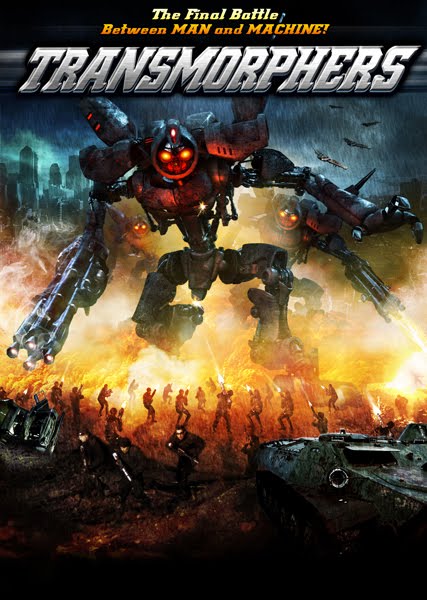
I, Go-Bot [Review: Transmorphers]

This is why I love The Asylum!

You may be surprised to hear that Transmorphers has nothing to do with the Transformers movie at all, taking its cue instead from The Matrix: Revolutions and the Terminator films. Following Earth's complete subjugation by an army of robots - possibly of alien origin - the last humans cower in an underground city, hatch their plans to take back the planet, and generally argue, bitch and catfight.

These robots don't actually transform into mechanical disguises, with a couple of exceptions (and incidentally, did the scriptwriters never see Tom Hanks in Big? Turns out he was right about something) but they do morph between flying, walking and heavy weapons configurations.

General Van Ryburg (Eliza Swenson) has a cunning plan - but naturally it's doomed to failure unless Mitchell (Matthew Wolf) - a revolutionary placed in suspended animation by Van Ryburg - is thawed out to lead the squadron. Complicating matters is Mitchell's former girlfriend Nadir (Amy Weber) who is now married to the General. The General was originally written for a man, and Eliza Swenson has been switched into the part with no changes to the plot or script - creating an interesting dynamic between the lead characters, plus a society that no longer bats an eyelid at either gender roles or sexuality - Captain Jack Harkness would fit right in.

Eliza Swenson as General Van Ryburg

Of all the Asylum movies I've sat through, this one probably has the highest production values - in that it has actual sets, many of which don't resemble painted cardboard. There are also a lot of giant robots, although sadly CGI and bluescreen footage are both overused and poorly executed. By contrast the acting, while not devoid of ham and cheese, is generally good - certainly the best thing about the movie. In addition to the leads, Matthew Tower stands out as the loopy Professor Alextzavich, and his sidekick Suzy the supercharged cyborg (Erin Evans, aka Erin Sullivan, half of the reason I enjoyed Monster so much) is woefully underutilised.

Friday, 5 November 2010

Rajni's Universal Robots [Review: Endhiran]

Endhiran (Robot) is a Tamil production starring Tamil superstar Rajnikanth and Bollywood's Aishwarya Rai Bachchan. Given the size of the Indian movie industry - and audience - I don't think I need to point out the significance of bringing these two names together in one film. Rajni plays android Chitti and also his creator Dr. Vaseegaran who would rather spend his nights in the lab with a soldering iron than with his long-suffering girlfriend Sana, played by Aishwarya Rai.

Even though the film is shorter than Return Of The King there is a hell of a lot of plot: Chitti goes from failed military prototype to superhero to love rival to supervillain, and the film rolls together ideas from RoboCop, The Terminator, I Robot, Bicentennial Man, very heavily from Short Circuit and probably every other robot movie book or play since Rossum's Universal Robots, while adding one or two twists of its own.

Endhiran also utterly disregards Western genre conventions combining elements of action, thriller, romantic comedy, slapstick comedy and black comedy and of course musical theatre, and there is absolutely no conflict between any of the styles: you get to have your cake and eat it.

I have one complaint: the subtitles. Endhiran has the worst English subtitling grammar I've ever seen. Sorry. I'm often disappointed in fellow cinemaphiles who miss out on some great films because they find subtitles too irritating - but this is exactly the kind of thing that gives subtitling a bad name. Incidentally, and just to drive the message home, you can see the best subtitling ever in this film.

As a Westerner with little experience of Bollywood or Tamil cinema I can report Endhiran is very watchable and I would recommend it to others outside the traditional audience. It has captivating stars and catchy music, it's full of ideas whether original or borrowed and it's fun from start to finish. I sincerely hope this leads to many more Bollywood-style sci-fi epics.

Saturday, 9 October 2010

Digital Scavengers!

AUTUMN
FUNNY
LOST
ENERGY
DANCE CONCRETECONFUSIONSMILE

Lifting Me Up's Digital Scavenger Hunt coincided with a visit to Birmingham. Check out these other Digital Scavengers who will also be posting photos on the same themes over the next few days:

Lifting Me Up

FreakSmack

Photography by Hank Plumley

Joocy Bits & Wotnots

Water Cooler, The

Soul Energy

Pink Dandy Chatter

The Sci-Fi Gene

Kent Today & Yesterday

Be Your Own Detective

Jerome Aoustin Photography

Jay.Me

Life, The Universe...

Click 'N Light

[update 12.10.10: final list of participants with direct links to their scavenger hunt photos]

Friday, 3 September 2010

Twisting The Night Away [Review: Twisted Metal]

A planet inhabited by mechanical creatures: self replicating humanoid robots that have evolved beyond their mysterious origins and built up their own cultures and societies. War is brewing between the two city states of Turing and Artemis, the former valuing individuality, sentience and creativity, the latter militaristic, fascist and impersonal. Welcome to Penrose, the harsh and unforgiving setting of Tony Ballantyne’s Twisted Metal.

The robotic biosphere of Penrose is imagined in rich detail – in addition to the humanoids with many variant body forms, there are robotic worms and other non-sentient mechanical creatures. Organic animal and plant life is present but sparse. Multiple viewpoints allow a broad exploration of the main cultures of the Shull continent – giving the sense of a complete overview of the workings of Penrose. However when the conquering robots travel further north they make some surprising discoveries.

Tony Ballantyne has given his robots human-like personalities and motivations, as well as a form of sexual reproduction and lovemaking – a male robot produces wire which the female robot twists into a functional robot mind. At the same time this is not simply a story about humans with mechanical bodies as many of the dilemmas faced by the robots go to the heart of their robotic, non-human nature. The storyline is brutal and desperately sad in places, particularly when dealing with Artemis’ processing of its captives and converts after a war: male captives are forced to kill each other or choose which of their fellows should be killed, while females are subject to the robotic equivalent of systematic rape as they are trained to create the perfect cloned Artemis citizens. However this has a bearing on the robots’ origins – did they evolve on Penrose? Or, were they originally designed to produce identical offspring? And if so, from where does the mother robot get her instinct to make her child’s mind unique?

On a lighter note, the book namechecks and references famous roboticists and artificial intelligence scientists, real and fictional, at every turn, from the planet, Penrose, to the hero of one plot strand Karel, and his robot wife Susan who I presume is named for Asimov’s Susan Calvin. In Turing City, a form of Turing test serves as the citizenship exam.

This novel has a great concept and setting, with lots of original elements and a strong plot. Some elements are clearly contrived in order to make parallels with human society – particularly the mode of reproduction – but even this is cleverly done. It’s a WALL-E or Robots for grown-ups, and I would much rather see a movie version of this made than more Terminator or Transformers numbers. The story continues in the sequel Blood And Iron, reviewed here by Cybermage.

Thursday, 17 December 2009

Ataque de Pánico! - the next District 9?

You may already have seen this: Fede Alvarez' short film "Ataque de Pánico!" made for £108 (plus muchisimas grasias) and uploaded to YouTube, which is in the news as it led to a slightly larger budget for the director's next feature.


Naturally I love the effects and camerawork! but also the simplicity: the giant figures appearing from the mist, the repeating music...

Thursday, 25 December 2008

Rossums Universal Robots remake?

Sorry. I'd love to see a cinematic re-make of this play, the Czech origin of the word "robot," but I doubt there's one on the cards.

Never mind - there are other ways to get your robot fix. Hidden amongst the trillions of pop videos out there are some brilliant pieces of short film. I have several non-sci-fi favourites but here's a sci-fi classic: Believe by the Chemical Brothers.


Merry Christmas!

Friday, 28 November 2008

Real life sci-fi: Čapek was right

Czech playwright Karel Čapek coined the phrase "robot" for a mechanical worker in his 1921 play R.U.R. (Rossum's Universal Robots). This play sees the robot workers rise up against their human masters and take over the world, but be careful about interpreting this as a West-style disaster epic - firstly, this is post-revolution, USSR so the robots are the good guys in a Marxist, proletariat versus bourgeoisie sort of way; secondly Čapek is an indiscriminate satirist and I don't think anyone in any of his plays is excused the sharp edge of his pen.

It seems Čapek may have been on to something. While computers get their digital hands on our companies and transport networks, the robots are making their move too. While our attention has been distracted, over the last few years robots have quietly taken over the choiciest human jobs. I mean, now robots can be camel jockeys, conductors, wine tasters, seals, fishes or sharks - I mean, what does that leave for us?