Predictably, "Ugly" here is another of my favourites:
 For more amazing pictures go to Tredowski's portfolio or blog. The Interzone website is here and you can read more about Interzone 222 here.
 Predictably, "Ugly" here is another of my favourites:
 For more amazing pictures go to Tredowski's portfolio or blog. The Interzone website is here and you can read more about Interzone 222 here.
 The novels making up a trilogy or series don't have to follow each other serially. Steven Baxter's trilogy Time, Space, Origin and the short story collection Phase Space are connected unusually - each tells a stand-alone story, but the characters and plot elements recur. Baxter uses parallel universes, and sends each story literally in a different direction, following a different space-time axis. Time follows the protagonist into the distant future, in Space he undertakes a very different voyage to the limits of space, while in Origin he finds himself cast from parallel universe to universe. The Origin here is also a reference to Darwin's Origin of the Species, and this novel explores alternative evolutionary possibilities.
 As in many of Baxter's novels, the author shows off his knowledge of the world's space programmes (each novel features a different, though equally plausible "Big Dumb" launch system) and of astronomy, physics and evolutionary biology. The science is so clearly described that these could easily replace secondary school textbooks. Space also features a good, if scary, answer to the Fermi Paradox.

 What's the attraction of steam power? These machines can be hypnotic to watch - literally given the number of spinning parts; they're noisy, dirty and dangerous and all of this draws and holds your attention. If you understand only a fraction of the underlying principles then it's clear that they have to be the shape they are - this is form completely following function. Yet the engineers still managed to embed flourishes and appealing shapes into the structure.
 There's also an official, Wells-estate-sanctioned sequel written by Stephen Baxter, The Time Ships. In this book time travel has consequences: the traveller has returned from the future and shared his experiences and this has changed the future. Baxter's story uses the time travel device to explore a range of imaginative scenarios including a First World War that has persisted for decades, and a future where the Morlocks developed very differently from Wells' description - all the while developing Wells' ideas about class and evolution.
 At Sci-Fi London, the future meant Docklands or the Jubilee Line. In Michael Winterbottom's Code 46, the future means Shanghai's business district. The film is beautifully crafted in general, with intense use of light, colour and vibrant sound to invoke emotional atmosphere. It also features two superb actors - Tim Robbins and Samantha Morton. Morton's accent is a bit WTF here (perhaps this is a genuine dialect of the future) but this is irrelevant as she creates a complex tough-yet-vulnerable character that gets your attention without the aid of an empathy virus.
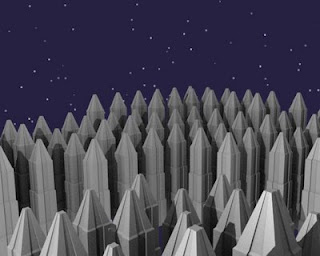 Some first steps in Blender
 The Nets of Space, a novella by Emil Petaja, was first published in 1969. My copy dates from 1972, and features an uncredited cover illustration of butchered astronauts in a Mercury-like capsule, and a United Kingdom RRP of 25p.


 Posts
All Comments
Posts
All Comments