Showing posts with label art. Show all posts

Saturday, 12 August 2017

Curved Space [Review: Into The Unknown]

"Into The Unknown" is an incredibly ambitious science fiction exhibition in London. In a relatively small gallery space, the Curve Gallery at the Barbican Centre, there is an attempt to tell the entire story of the science fiction genre, from its' origins ito the present day, it's development across different continents and cultures, and across media including books, films, art, architecture, music, games and more, at the same time exploring the many different concepts that appear in sci-fi. The result is fascinating - an Aladdin's Cave of real treasures that can be explored and enjoyed, interspersed with shelves of sci-fi novels and screens showing clips from classic films.

The main gallery is full of surprises - an interactive Mission Control scene from The Martian, a viewing/listening post dedicated to Afrofuturism, and a short sci-fi film with a script written by a predictive text AI. Outside the main gallery the quest continues with exhibits hidden in nooks and crannies elsewhere in the Barbican. A particularly interesting find was Larissa Sansour's experimental film "In the Future They Ate from the Finest Porcelain" with its' theme of archaeological warfare.

"Into The Unknown" can be seen at the Barbican Centre from 3rd June until 1st September 2017. The website is here.

model of airship "The Albatross" from Jules Verne's novel Robur The Conqueror
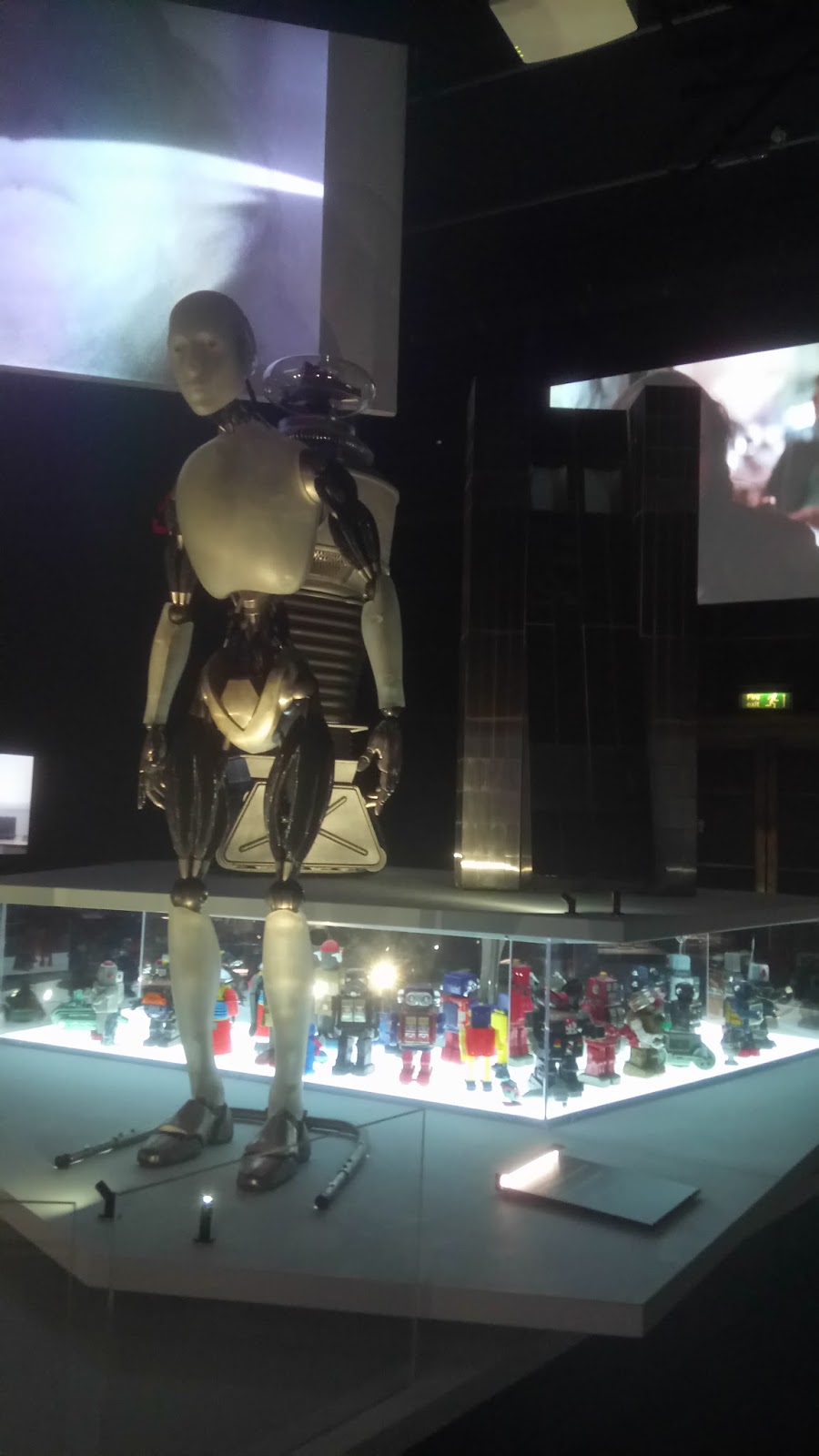
robots including Sonny from I, Robot and TARS from Interstellar
model of the miniature submarine from Fantastic Voyage
spacesuits from Star Trek V and Moon
 the portable shared-dreaming device from Inception

Sunday, 25 July 2010

Warped Genius [Review: Surface Warp Factor]

Surface Warp Factor is not the work of sci-fi or fantasy artists or illustrators but an exhibition by a group of artists taking their inspiration from science fiction, recently on display at the Aubin Gallery in London.

"Suncatcher II" Tom Ormond

For me, one of the most powerful aspects of science fiction is the sense of scale: authors such as Larry Niven, Stephen Baxter and Iain M. Banks write tales of engineering on city, country, planet, solar system or even galaxy-wide scales; while often in films we are presented with objects that defy scaling - how big is the Starship Enterprise for instance? Tom Ormond's canvasses play with scale and engineering while remaining abstract and perplexing: his geodesic hemisphere ("Suncatcher II") could be a house, a city or a hollow planet; his floating sphere ("Hardtack Moon") could also be a machine planet or star of some kind - but if so, what is it hovering above? Haunting colour schemes depict sunset and starlight respectively.

"Hardtack Moon" Tom Ormond

Ormond's work was the highlight for me of an extremely creative exhibition that also included Stewart Gough's sculptures from plumbing materials, Gordon Cheung's fractal dragon, Richard Ducker's abstract creations that play with shapes, angles and textures, and Sheena Macrae's video installation "Odyssey" in which iconic scenes from Kubrick's "2001: A Space Odyssey" are broken into horizontal bars and combined to mesmerizing effect.

"Fallen Warrior" Stewart Gough

I also enjoyed the gentle humour of Diann Bauer's ink drawing and Juan Bolivar's greyscale images.

"To Boldly Go" Juan Bolivar

Regretfully this exhibition is now closed but you can see other works by Gordon Cheung at the Zero 10 gallery, and by Richard Ducker at the Oblong Gallery and Elastic Residence. I should add that this is the second exhibition I've seen at the Aubin Gallery and both times I've been impressed by the creativity and ingenuity they've been able to bring together - the future is bright.

"Dragon Dance" Gordon Cheung

All pictures are copyright to their respective creators and are reproduced here with the kind permission of the Aubin Gallery.

Friday, 17 July 2009

Walking In My Mind

The Hayward Gallery's summer exhibition for 2009, Walking In My Mind, features several artists' attempts to portray the inside of their own minds. I like installation art in general - there's something very appealing about being able to walk into a picture. Installation art is also a perfect medium for this particular topic. In one sense, any installation, or any art form, is a representation of at least part of the mind of the artist - after all, where else can it have come from? However many of these exhibits take a very literal approach and attempt to portray both the content and the process of mind.

Jason Rhoades' work, The Creation Myth, for example fills a room with a bizarre, Heath Robinson-like machine representing the creative process - there's a trail of cables taking you through a series of sub-processes. It's a disturbing exhibit; sound, movement and smoke effects keep you uneasy, and Rhoades uses a lot of pornographic imagery - this has led to some discussion in the press but is completely appropriate in the context of portraying the range of thoughts that pass through a human mind, or the creative process; to my mind it also makes the work honest and personal.

Yoshitomo Nara also takes a literal approach, building a one-room house storing memories and personal, meaningful possessions, while you can explore Thomas Hirschhorn's mind in the form of a network of caves made from cardboard and tape. Yayoi Kusama creates a more surreal, beautiful experience - walking into a red and white polka dot universe which extends onto this balcony:


There are also exhibits by Charles Avery who continues to expand his fictional Island, including this artefact of it's culture - a mysterious, dimensionally transcendent cabinet.

Science fiction also grapples with this theme from time to time - say, Stephen King's novel Dreamcatcher where an alien presence banishes a character into his own mental space, or The Cell, where a psychiatrist literally enters her patient's thoughts to diagnose and heal them. It's a difficult concept to make convincing, just as it's difficult to invent realistic dreams or simulate insanity, and both these examples are flawed. This exhibition succeeds because each installation seems to communicate something real, and surprisingly frank, about the mind of its' creator.

Wednesday, 5 November 2008

Only Happy When It Rains

Sci-fi inspired the current Turbine Hall installation at the Tate Modern - TH.2058 by Dominique Gonzalez-Foerster. Many previous TH installations have a kind of sci-fi edge to them - for example the first in the series was Louise Borgeouis's giant spider Maman; they're also the more playful side of modern art, recent installations including a series of metal slides and a giant crack in the floor.

For TH.2058 the Turbine Hall has been converted into a shelter, complete with yellow and blue bunk beds, to protect Londoners from a perpetual rainstorm 50 years in the future. Sharing the space with the humans are giant versions of other works of art - including an even larger re-make of Maman, and the skeleton of some extinct mammal. At one end The Last Film is playing - a collage of film clips including sequences from some sci-fi classics including THX 1138, Invasion of the Body Snatchers, Solaris, Soylent Green and so on.

The attention to detail makes walking through the shelter extremely evocative. Strange robotic insects stick to the walls with coloured lights on their backs. Books are littered around on the bunk beds, you can pick them up and leaf through. Naturally they include War of the Worlds and The Drowned World, as well as other apocalyptic classics. A radio is bolted to one of the bunk beds - someone is still broadcasting from somewhere else in the world. As you walk towards the exit the sound of dripping water gradually grows into the sound of the rainstorm outside.

Where are the people? Gallery staff are present wearing fluorescent jackets so could be the marshalls; otherwise the inhabitants have disappeared, leaving their books behind - or possibly we are cast as the survivors, getting used to our new living arrangements. The advantage of the Turbine Hall as an artistic space is that the artist can create really immersive experiences - much better than virtual reality - so this was my experience. The radio was a particularly poignant touch.

The descriptive leaflet explains that this is not purely a work of sci-fi but also continues themes Gonzales-Foerster has been working on over the last twenty years - as well as being a response to other works of art including those recreated here. This is still a cool experience for a sci-fi fan and, like the best art, evokes all sorts of emotions and thoughts as you pass through its shadow.